Showing posts with label community. Show all posts

Tuesday, September 27, 2011

US mobile phone usage - hyperconnected youth

There aren't many digital and media stats that make my jaw drop. Sure, Facebook's stats are staggering, but its walled garden business model has helped it create a near monopoly on family social networking.

Then along comes a Pew Internet study that shows that:

Young adults are the most avid texters by a wide margin. Cell owners between the ages of 18 and 24 exchange an average of 109.5 messages on a normal day—that works out to more than 3,200 texts per month—and the typical or median cell owner in this age group sends or receives 50 messages per day (or 1500 messages per month).

An average exchange of 109.5 text messages per day.

That made my jaw drop. Maybe because now that I'm 30 i'm considered a mobile senior citizen or maybe I just don't have many friends.

Consider the time it would take to receive then send that many messages and then add other social networking activities such as Facebook and Twitter. That is dedication to connection.

The Pew Internet and American Life Project contains plenty of informative research, have a good read.

Tuesday, July 19, 2011

Teamwork

Photo credit: Ian Joyce

I love the Tour de France. The teamwork required to complete a race of over 3,000km is astounding. Mark Cavendish has summed it up perfectly:

"I crossed the finish line first, and I've done that 19 times now," he said, "but that's because there's only one person who can cross the finish line first. I did 200 metres today in a 200‑kilometre stage. Two of my team‑mates rode for 190 of those kilometres and the rest took over and delivered me to the line. So although it's my name on the list, it's for the team."

Read more about his stage win.

Friday, September 10, 2010

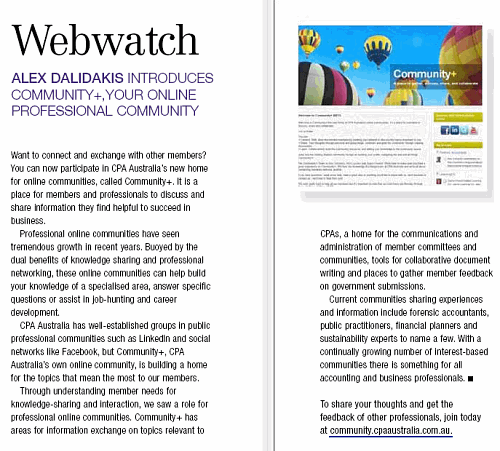
Online communities for accountants

So, the time has come that I finally get my name into the press (the printed press I mean...). Here is the article from CPA Australia's InTheBlack magazine (circulation 124,858).

Read it online here.

Monday, March 22, 2010

Integrating your loyalty program into your customers communities

So you're a retailer and you have a customer loyalty program, nothing new there, everyone does. But until now this has been a mostly one-to-one relationship. Maybe you're a forward thinking company like Sears and have built a community for your loyalty program or like Best Buy and built a youth community for a specific segment of your customers. Breaking the one-to-one mould and exposing loyal customers to each other, great.

This means big bikkies to create a community platform from scratch and one of the down sides of this is that your brand is essentially insulated within its own community boundaries. For smaller retailers there is an alternative that can generate exposure as well as community.

I originally got on this train of thought when I read a blog post by platform vendor Lithium and their integration of Foursquare into their platform. This was more of a comment on bringing outside community mentions into an enterprise community, but the concept of blending inside and outside communities is essentially the same.

And now I have come across Tasti D-lite, a US ice-cream chain that has really taken social media integration to the next level for small business.

You can read more about how Tasti D-lite have brought social media into their loyalty program here, but essentially what they have done is leverage the power of their customer's existing free and public networks to promote their own loyalty program.

For USD$10,000 Tasti D-lite integrated Twitter and Foursquare into their loyalty program and POS system so that when a transaction is made using the loyalty program card a Tweet is sent with how many points were awarded and a check-in is made in Foursquare for the customer.

Setting aside the mammoth amount of small business activity in Facebook, this example shows how for relatively small amounts of money small businesses can leverage the power of their customer's existing networks to build brand and loyalty together.

Monday, March 15, 2010

modern living

A house nearby recently had a syntheic lawn installed in the front yard (not the one pictured) and it made me contemplate how far, or how little, we have come in adapting to the realities of today's climate.

It would seem that in society today we are happy fantasize about green lawns through synthetic dreams in the vain hope saving precious drops of water.

One might be tempted to link this to notion that says Australians are not yet willing to drink potable recycled sewage.

How vain we must be that we would rather live in a synthetic dream than adapt to the realities of today.

In Victoria today we are building a de-salination plant to supplement our thirst for water which, if recycled, we would have in abundance. Houses across the nation are installing water tanks to 'do their part' in capturing rainfall for use on the garden.

It makes me wonder, what do Victorians treasure more, their vanity or their gardens? It would seem that if the we reject recycled water and prefer synthetic gardens then our vanity wins out.

(image credit: Aquafornia)

Thursday, January 21, 2010

Convergence culture


I've started reading Henry Jenkins' Convergence Culture and even though I'm still just on the introduction the story that he's telling really resonates with me. The convergence, as I understand it, is that a story is its own self and is not beholden to a delivery medium. The story will reveal itself to you in the most appropriate manner to have the biggest impact. Thus, the delivery medium/s of a story converge to become a single ecosystem in which the story unravels. Today, more than ever, this convergence is available to the story-teller.

I'll get back to you with more stuff that I learn from Mr.Jenkins, but for now I'll leave you with some fun convergence you might be familiar with...

... Amazon reviews!

I love comedy, I love it even more when it is set in a context that you just wouldn't expect it. The lampooning of products on Amazon is some of the funniest stuff I've read on teh Interwebs. And what's more, Amazon, with its 'helpfulness' ratings for reviews, is complicit in helping these reviews be just as popular, if not more so, than the products themselves.

Crap Amazon products and comedy, there's convergence for you!

Here's some of the classics, please comment with more if there are!

Tuesday, January 12, 2010

What's the use of social ratings?

Welcome to 2010! Bad Religion may have been a couple of billion people off predicting 10bn in 2010, but we'll let that one slide.

One of the other things that is upon us in 2010 is the long tail of social media ratings and measurements. My previous post started a list of ways online communities and websites are now managing a measuring reputation and community involvement. Now what I am finding is that, like many ideas on the Web, the long tail of obscure and sometimes half-baked ideas is stretching the usefulness and relevance of community input variables.

I mention this because today Jeremiah Owyang pointed towards the KickApps mood widget (right) on the NBC New York news site. You can now rate how an article on the news site makes you feel. Based on a pre-defined set of moods you can help define how the city of New York is 'feeling'.

This made me recall the Yelp review widget where you can say whether a restaurant review was useful, funny or cool (below). These 'mood' or semantic ratings seem a little odd to me. There are two reasons for this feeling. One, as a reader or community member I do not see value being created by defining articles by semantic terms unrelated for the most part to the actual article. In Yelp's case, would I choose to go to a restaurant because a reviewer the reviewed the restaurant is considered funny? Or will I post more restaurant reviews because people think my reviews are cool? I dunno.

As for the moods on NBC New York, do I get value out of the fact that readers are thrilled about an article on Marijuana and bored about an article on politics? As a rating it does not make one thing more valuable than another because the variables are nominal. Possibly I might want to search for 'thrilling' articles, I probably wouldn't search 'boring' articles.

Which brings me to point two, browse-ability and search-ability. Presumably these ratings/variables have been created to be useful for website/community users. But if you cannot filter any of the variables then how can they be useful? A good rating or social measure in a community should both provide value to the content creator (people think this is great!) and value to the rater (that article is great! I'll rate it 5 stars so more people can see it). Update: Thanks to reader JZ, they've pointed me to the NBC Mood Board where you can filter based on mood.

Both Yelp and NBC/KickApps have gone half way with their semantic ratings, and there is nothing wrong choosing nominal variables to try to define a mood or a feeling, but thats only the half of it. The other half is the usefulness half, ask, "how will other people find this useful?"

Ratings, reputations, rewards, and now feelings, are all ways communities are trying to promote the value community members receive from the community, but for these things to catch on the members need positive and tangible results from their interactions that can further deepen their connection with the community.

Tuesday, December 22, 2009

List of online reputation and community involvement examples

Earlier in the year I blogged about rewarding community involvement online and came up with this 2x2 matrix to help me categorise the millions of methods of rewards out in the ether.


I thought that the best way for me to keep the momentum going on this train of thought was to begin a list of examples from the web that showcase all the different methods communities are employing.

This list will be updated periodically as new examples come to light. Enjoy!

***
Legend: Location: Reward (How attained) Scale

Measurements of rewards are based on social sciences scaling using either individual attributes scaled as either Nominal, Ordinal, Interval or Ratio or as a composite measure such as an Index or Typology. (Please excuse me if I don't get some of these measures correct and do comment to help me improve!)

As a brief re-cap I am defining subjective as any kind of reward where human interaction is needed in some part of the process where objective rewards are based solely on a pre-determined formula.

Subjective Periodic

  • eBay: Power Seller (eBay awards power seller status based on a mixture of objective achievements and subjectively adhering to community policy) Index
  • Yelp: Review of the day (Be the reviewer of the day in a Yelp city) Nominal

Subjective Perpetual

  • Amazon: Badges (Get a 'real name' or 'The' badge if Amazon thinks you are popular enough) Nominal
  • Twitter: Verified (If you're a celebrity Twitter can verify you are the actual account holder) Nominal
  • Twitter: Translate (If you help Twitter as a translator you get Translator badge) Nominal
  • Wikpedia: Barnstars (Peers award barnstars for participation in Wikipedia community) Typology
  • Yelp: Elite (Annual badge awarded for influential people in a Yelp city) Nominal
  • Yelp: Compliments (The community awards users compliments on reviews, compliments shown in public) Typology / Ratio

Objective Periodic

  • Ad Age: Power 150 (Marketing blogs ranked by aggregate of measurements) Index
  • Amazon: Feedback (Rating of transaction out of five stars) Ordinal
  • Amazon: Badges (Be a top reviewer) Ratio
  • at15.com: Best-Buy youth community Points (Complete activities to earn point, points directed to charity donation quarterly) Ratio
  • eBay: Helpful Reviewer (Be one of the top reviewers in eBay) Ratio
  • Foursquare: Mayor (Become mayor of a venue by being the person that checks in the most) Ratio
  • Technorati: Authority (More links to your blog mean more authority, calculated and updates frequently) Index
  • World of Warcraft: Reputation (Earn reputation points through doing deeds for other, reputation fluctuates based on whether you do good or bad deeds) Index

Objective Perpetual

  • at15.com: Best-Buy youth community Icons (the more points you earn the 'blingier' your icon becomes) Ratio
  • Facebook (Translations app): Awards (earn icons for quantity and accuracy of translation submissions) Ratio / Typology
  • Foursquare: Badges (earn points and badges by completing tasks, eg four bars in one night, be the first to review a venue) Ratio
  • Sears: Badges (earn points in MySears to enter the "Friends" - "Chairmans" Circle) Ratio
  • Soundunwound: Records (number of edits gets you coloured record) Ratio
  • World of Warcraft: Experience / PvP Rewards (earn items through increased game play, items traded for honour and other experience points) Index
  • Virgin.com : Badges (Rise from groupie to roadie then rockstar) Ratio

Thursday, December 10, 2009

Can I say trans-informational?

In the old marketing text book that I used to read at University there was a great section on informational advertising and transformational advertising and I really took those two theories to heart.

It was pretty simple really, informational advertising was used in important decision making processes. It was to remove fear like medicinal advertising or explain complex expensive products (you know those car comparison ads that list how many cup-holders a car has?). Then there was transformational advertising used either to gratify the ego with a minor purchase decision like how a can of coke will get me a whole lotta chicks in bikinis, or to satisfy the ego with large purchases like how when I bough my new Macbook I just knew that I would become hip.

But what I'm experiencing nowadays is that there is definitely a middle ground. And I think this middle ground is growing with the growth of online communities and networks.

Let me explain. Transformation feeds the ego and gratifies the individual while information gives the individual the required understanding of the needs required to go from being without satisfaction to having satisfaction. What better way of getting in the clique than by joining a community of experts and conversing and learning from the experts on how to transform yourself.

It is these online communities and networks that I believe fill the middle ground between information and transformation. This is the trans-informational advertising. Get this space right, create a space for the expression of emotion and transfer of knowledge, feed it with the occasional talking point of content and the community will can self-sustaining.

Example: The 2010 Ford Mustang
The new 2010 Ford Mustang is in anybody's book a pretty big purchase. To sell one of these babies you need to latch onto a heap of emotion, give lots of sexy information about the power of the beast, and of course have a space where fans and potential buyers can salivate together about this animal.

Let's start with tansformation. This is a beast of a car and has no practical use on the speed regulated roads whatsoever. But it is sexy, fast and down right red-blooded Amrerican muscle. Tell me this doesn't transform you:


Now information. You want specs? I'll give you specs. Take those details and shove 'em up your imported piece of plastic. As much as information is there to remove the fear of purchasing an inferior product it can also be used to reinforce your decision for buying an over-specced rocket on four wheels.

And the middle ground. I love these videos, I think this car is awesome, I want to salivate with someone over the fact that I could get the top of the range model for under $50k Australian!!! (if you didn't take into account import taxes, and every other obvious barrier under the sun to getting one in Australia).

Ford services this middle ground with a very healthy Facebook fan page with over 350k fans and a very nice assortment of photos, videos and applications to play with and discuss intimate stories about abnormal love affairs with inanimate objects. Facebook, as you can see from this example is the perfect platform for servicing this new and exponentially growing marketing ground.

The trans-informational middle ground is one of the most promising developments happening in marketing today. The opportunity to combine emotional transformational wants and rational informational needs in a living community of enthusiasts, executed thoughtfully and in the community's interest, can only strengthen a brand in the eyes of its core market.


*For more awesome mustang photos I recommend the Mustang fan page.

Thursday, July 23, 2009

Livestrong and the STAGES exhibition


STAGES09

I am a big fan of Lance Armstrong. I am a big fan of the Lance Armstrong Foundation, Livestrong. If every charitable foundation could have a Lance Armstrong in it we'd all be in a better place.

Here's what's great about the man and the foundation - their both driven; relentless; passionate; positive; creative; loved and loving. Basically they know what they want and they're going to get it.

Forget about the fact Lance is back in the Tour, That's just the dressing on top - the real reason Lance is in Europe is to promote Livestrong. In Paris during and after the race the STAGES art exhibition is on show (the video above describes Shepard Fairey's entry in the exhibition) and in August Lance and Livestrong will be in Dublin for a summit to further promote the foundations good work.

Lance's involvement in sport and in art shows everyone that can get involved in an honest and positive way. Nike's continued involvement with Livestrong and support of STAGES should be seen as a model for corporate partnerships and giving back to the community. The artists eagerness to be involved in this campaign also shows the amount of respect Lance has across industries, interests and cultures. Uniting sport and art has been one of the hallmarks of the Lance Armstrong Foundation. It's an odd marriage but through the single focus of fighting cancer Lance has drawn the best out of everyone involved and we're all the better for it.

Tuesday, July 21, 2009

Ratings and Reviews to build trust and reputation online

Building engagement online, especially building the engagement of community members from a low involvement level is a challenge. Increased engagement will follow the increase in the trust of members and content and in-turn member reputation will increase with increased positive engagement.

First, however, members need to be given an easily identifiable way of increasing the trust in content they give and take from a community and a fun and rewarding way of building their reputation in an online environment.

One of the most straight forward ways to create engagement online is giving members an option to rate and review content online. This activity which can be either recognised or anonymous allows others to build a scale of trust with the content based on the values of the community.

But wait, you thought it was simple, well, it's not that simple. Here's a list of things to think about if you want to go down the rate and review path:

Rating scales

What scale will you choose for your ratings? The following scales are methods of rating content and events, the list progresses from simple to sophisticated.

Favourite/Digg/Thumbs eg. Eventful, Digg, Marketing Magazine
This is not so much a scale as a popularity rating, here customers can see how many other people rate the event.

Smilies eg. Jango
On a scale of three smilies, a customer can "not like", "like" or "love" a specific song.

Single five star eg. Crikey
Quality is reviewed on a single five-star scale, generally sufficient for items with single measurement, eg news items are rated for quality of content.

Multiple five star
eg. eBay
Quality is rated over multiple criteria, average is generally shown in a summary five star. Used when customer decision is based on multiple criteria.

Classes eg. Wikipedia
Used in Wikipedia to classify the quality of an article, teams of people review articles and agree on a level of quality based on a set of common measurements.

Rating AND Commenting/Reviewing

As well as varying scales from which to rate, there is question of arbitrary ratings or subjective comments and reviews. Some websites link the two together while other keep the two separate, examples being:

Rate and comment/review separate: YouTube, Crikey

Rate and comment/review together: Amazon, JS-Kit Review applet

Who can rate?

This, again is a variable in many different rating schemes. Roughly following the same lines as scales, the more technical the content becomes the more selective the list of reviewers/raters become.

Anyone - Generally occurs in blogs and some news sites and generally on the favourite/thumbs scale. This level of interaction encourages high volume rating of non-technical items.

Registered members - Highly used in communities such as YouTube, raters are required to sign-in to rate therefore encouraging continued community membership and higher engagement.

Purchasers only - Used in many online e-commerce stores such as Amazon and eBay, this method is particularly relevant for events, whereby many of the rating criteria can only be completed by those that attended.

Team/Editor Review - Not as authoritative as peer reviewed, the team/editor review is a rating given by an assigned professional reviewing the content. Examples include Lonleyplant.com's author pick.

Peer Reviewed
- Articles are reviewed by an agreed group of peers. Knowledge and consensus combine to ensure an article is given an agreed rating by experts in the field.

So that's a start! Who would have thought such a simple thing as rating and reviewing could have so many variables?

Remember that this is just one side of the coin. This post looks at building trust and reputation in the content. This is based on the general assumption that you trust the community members that provide the ratings and reviews.

To get more of an understanding on the flip-side of the coin, building trust and reputation in community members, have a read of my post on rewarding community members online. This will help you understand ways you can allow community members to build up their status within a community.