
The bear rouses, from his slumber... yes, it's been a while between posts, but hopefully you can excuse me!
I've read a number of articles this week that have driven me to post again, and surprise, surprise, its another post about online video production (I just can't get enough of it!).
Here's whats got me all excited...
MangnaGlobal, media strategists and forecasters have predicted that online advertising will overtake newspapers as the second largest advertising medium by 2013.
ComScore, have released the latest online video consumption figures with stating, "In Australia, 10.3 million unique viewers consumed online video content during the month, averaging nearly 8 hours per viewer."
And finally, here's another example of big brands taking to the Internet with custom videos designed for the online world... Kevin Bacon for logitech and Google.
Showing posts with label brands. Show all posts
Showing posts with label brands. Show all posts
Wednesday, December 8, 2010


Monday, March 22, 2010
Integrating your loyalty program into your customers communities

This means big bikkies to create a community platform from scratch and one of the down sides of this is that your brand is essentially insulated within its own community boundaries. For smaller retailers there is an alternative that can generate exposure as well as community.
I originally got on this train of thought when I read a blog post by platform vendor Lithium and their integration of Foursquare into their platform. This was more of a comment on bringing outside community mentions into an enterprise community, but the concept of blending inside and outside communities is essentially the same.
And now I have come across Tasti D-lite, a US ice-cream chain that has really taken social media integration to the next level for small business.
You can read more about how Tasti D-lite have brought social media into their loyalty program here, but essentially what they have done is leverage the power of their customer's existing free and public networks to promote their own loyalty program.
For USD$10,000 Tasti D-lite integrated Twitter and Foursquare into their loyalty program and POS system so that when a transaction is made using the loyalty program card a Tweet is sent with how many points were awarded and a check-in is made in Foursquare for the customer.
Setting aside the mammoth amount of small business activity in Facebook, this example shows how for relatively small amounts of money small businesses can leverage the power of their customer's existing networks to build brand and loyalty together.
Thursday, February 18, 2010
The good company
What makes a company good? And by 'good' I mean good for everyone, the world, the whole box and dice. Talk to some economists and they would say the only responsibility a company has is to its shareholders. Make sure the shareholders get as much cash as possible and let the individual make the decision. Talk to others and they'll say a company can be good only by being a good corporate citizen. This is more ill-defined, but generally one would say this means ethical business practices, giving back to the community, lowering carbon emissions and the like.
I've been put on this train of thought because of an article written by Umair Haque on the HBR blog. The Great to Good Manifesto largely explains this phenomena and picks out Pepsi's latest 'Refresh' campaign as a key example.
While the scale of this good company principle varies immensely, especially from industry to industry, it would seem that at least in the FMCG and bulky-goods industries, the more holistic style of good company is rising.
Examples of how these FMCG companies are becoming good companies seem to be coming through more and more frequently. Using the criteria of ethical business, giving back to the community and lowering carbon emmissions we see that industries are increasingly seeing the commercial benefits of being good companies.
From an ethical point of view green is the new black and companies far and wide are both promoting their green credentials and giving customers the option of greening their products (a la carbon offsets for flights and car-hire). In the FMCG market one of the highest profile decisions has been Cadbury's decision to become Fairtrade certified in its Dairy Milk branded chocolate. You can read more about their efforts on the Cadbury Fairtrade blog.
By far the hottest good thing companies are doing at the moment is giving back to the community. The idea of integrating good corporate citizenry and marketing promotions is really taking off. You can debate whether this is opportunistic or not until the cows come home, but there is a clear trend towards customer purchasing decisions being made based on a company's propensity to 'give-back'.
FMCG organisations are going on the 'give-back' offensive across the board and it has started in the tween and teen market. Social networking is increasingly giving tweens the power to decide en-mass and their role in purchasing decisions cannot be under-stated.
Examples of the tween community offensive include the Pepsi Refresh campaign, Best-Buy's @15 community, and closer to home Starburst has teamed up with Camp Quality.
A third good company criteria is the company's carbon reduction actions. This strategy, partly driven by legislation and probably more focused at the adult community, is more prominent in essential FMCG goods and shareholder information. Woolworths in Australia has committed to reducing CO2 emissions through improvements in store operations (example: refrigeration) and logistics. In the UK Tesco now identifies the carbon footprint of its milk products on the product label.
What is a good company? It would seem the days of measuring how good a company is solely by shareholder return are numbered. If the promotions by Pepsi, Best-Buy and Starburst are anything to go by the holistic good company is on the rise.
I've been put on this train of thought because of an article written by Umair Haque on the HBR blog. The Great to Good Manifesto largely explains this phenomena and picks out Pepsi's latest 'Refresh' campaign as a key example.
While the scale of this good company principle varies immensely, especially from industry to industry, it would seem that at least in the FMCG and bulky-goods industries, the more holistic style of good company is rising.
Examples of how these FMCG companies are becoming good companies seem to be coming through more and more frequently. Using the criteria of ethical business, giving back to the community and lowering carbon emmissions we see that industries are increasingly seeing the commercial benefits of being good companies.
From an ethical point of view green is the new black and companies far and wide are both promoting their green credentials and giving customers the option of greening their products (a la carbon offsets for flights and car-hire). In the FMCG market one of the highest profile decisions has been Cadbury's decision to become Fairtrade certified in its Dairy Milk branded chocolate. You can read more about their efforts on the Cadbury Fairtrade blog.
By far the hottest good thing companies are doing at the moment is giving back to the community. The idea of integrating good corporate citizenry and marketing promotions is really taking off. You can debate whether this is opportunistic or not until the cows come home, but there is a clear trend towards customer purchasing decisions being made based on a company's propensity to 'give-back'.
FMCG organisations are going on the 'give-back' offensive across the board and it has started in the tween and teen market. Social networking is increasingly giving tweens the power to decide en-mass and their role in purchasing decisions cannot be under-stated.
Examples of the tween community offensive include the Pepsi Refresh campaign, Best-Buy's @15 community, and closer to home Starburst has teamed up with Camp Quality.
A third good company criteria is the company's carbon reduction actions. This strategy, partly driven by legislation and probably more focused at the adult community, is more prominent in essential FMCG goods and shareholder information. Woolworths in Australia has committed to reducing CO2 emissions through improvements in store operations (example: refrigeration) and logistics. In the UK Tesco now identifies the carbon footprint of its milk products on the product label.
What is a good company? It would seem the days of measuring how good a company is solely by shareholder return are numbered. If the promotions by Pepsi, Best-Buy and Starburst are anything to go by the holistic good company is on the rise.
Thursday, December 10, 2009
Can I say trans-informational?
 In the old marketing text book that I used to read at University there was a great section on informational advertising and transformational advertising and I really took those two theories to heart.
It was pretty simple really, informational advertising was used in important decision making processes. It was to remove fear like medicinal advertising or explain complex expensive products (you know those car comparison ads that list how many cup-holders a car has?). Then there was transformational advertising used either to gratify the ego with a minor purchase decision like how a can of coke will get me a whole lotta chicks in bikinis, or to satisfy the ego with large purchases like how when I bough my new Macbook I just knew that I would become hip.
But what I'm experiencing nowadays is that there is definitely a middle ground. And I think this middle ground is growing with the growth of online communities and networks.
Let me explain. Transformation feeds the ego and gratifies the individual while information gives the individual the required understanding of the needs required to go from being without satisfaction to having satisfaction. What better way of getting in the clique than by joining a community of experts and conversing and learning from the experts on how to transform yourself.
It is these online communities and networks that I believe fill the middle ground between information and transformation. This is the trans-informational advertising. Get this space right, create a space for the expression of emotion and transfer of knowledge, feed it with the occasional talking point of content and the community will can self-sustaining.
Example: The 2010 Ford Mustang
The new 2010 Ford Mustang is in anybody's book a pretty big purchase. To sell one of these babies you need to latch onto a heap of emotion, give lots of sexy information about the power of the beast, and of course have a space where fans and potential buyers can salivate together about this animal.
Let's start with tansformation. This is a beast of a car and has no practical use on the speed regulated roads whatsoever. But it is sexy, fast and down right red-blooded Amrerican muscle. Tell me this doesn't transform you:
Now information. You want specs? I'll give you specs. Take those details and shove 'em up your imported piece of plastic. As much as information is there to remove the fear of purchasing an inferior product it can also be used to reinforce your decision for buying an over-specced rocket on four wheels.
And the middle ground. I love these videos, I think this car is awesome, I want to salivate with someone over the fact that I could get the top of the range model for under $50k Australian!!! (if you didn't take into account import taxes, and every other obvious barrier under the sun to getting one in Australia).
Ford services this middle ground with a very healthy Facebook fan page with over 350k fans and a very nice assortment of photos, videos and applications to play with and discuss intimate stories about abnormal love affairs with inanimate objects. Facebook, as you can see from this example is the perfect platform for servicing this new and exponentially growing marketing ground.
The trans-informational middle ground is one of the most promising developments happening in marketing today. The opportunity to combine emotional transformational wants and rational informational needs in a living community of enthusiasts, executed thoughtfully and in the community's interest, can only strengthen a brand in the eyes of its core market.
*For more awesome mustang photos I recommend the Mustang fan page.
Tuesday, November 24, 2009
The new division of marketing labour
The debate over marketing as an activity within an organisation is nothing new. In retail organisations it's a pretty simple model that product management and marketing fit snuggly together whereas operations/sales-force and customer service go together on their merry way spruiking the line they've been given from the former departments.
Service organisations can be a little more blurry between departments but the general principles still exist that one side manages the product and message and the other side manages the customer and company operations.
But the socialising of consumption and business is melting these generally held principles and we are now seeing a multi-coloured pool of muck on the floor and a metaphorical "watch out, slippery floor" sign has gone up around the whole marketing/customer-service model.
Laurel Papworth has been championing the 'social business interactions belong in customer service' thing for a while, here's her category posts for customer service, so like I said it's nothing new.
BBH-Labs has also picked out some juicy points in its review of Razorfish's third annual digital brand experience report. Particularly BBH-Labs points out "... the silo walls between marketing & customer service teams in particular need breaking down; they are increasingly one and the same thing ..."
I know at my own job the business is only just defining its voice in an online world: is it customer service, news service, sales service; is it formal, informal; pro-active or reactive?
It's possible to even take this one step further and ask if it is even possible for a business to define its online personality, or is it the customers that define it for them? I think, just like a steamy first date, the relationship will be defined by the mimicry of interactions between the two.
All these philosophical questions aside I agree with both Laurel and BBH-Labs that the socialisation of business will ultimately draw marketing closer to customer service.
For a marketing manager that has paraded from advertising agency to sponsorship events and around the board table to have to grind away the hours with customer service and on the shop floor will be too much for some. Some businesses will refuse to change, refuse to engage with the customers. I believe that those that refuse to adapt to this new division of marketing labour will struggle to grow.
So I say to the marketing managers that are asking 'their agencies' to create a social media campaign for them, stop. It's not sustainable. You have to look within yourself and your brand, as the brand ambassador only you can create the social business your brand deserves. And it will include talking to customers yourself.
Service organisations can be a little more blurry between departments but the general principles still exist that one side manages the product and message and the other side manages the customer and company operations.
But the socialising of consumption and business is melting these generally held principles and we are now seeing a multi-coloured pool of muck on the floor and a metaphorical "watch out, slippery floor" sign has gone up around the whole marketing/customer-service model.
Laurel Papworth has been championing the 'social business interactions belong in customer service' thing for a while, here's her category posts for customer service, so like I said it's nothing new.
BBH-Labs has also picked out some juicy points in its review of Razorfish's third annual digital brand experience report. Particularly BBH-Labs points out "... the silo walls between marketing & customer service teams in particular need breaking down; they are increasingly one and the same thing ..."
I know at my own job the business is only just defining its voice in an online world: is it customer service, news service, sales service; is it formal, informal; pro-active or reactive?
It's possible to even take this one step further and ask if it is even possible for a business to define its online personality, or is it the customers that define it for them? I think, just like a steamy first date, the relationship will be defined by the mimicry of interactions between the two.
All these philosophical questions aside I agree with both Laurel and BBH-Labs that the socialisation of business will ultimately draw marketing closer to customer service.
For a marketing manager that has paraded from advertising agency to sponsorship events and around the board table to have to grind away the hours with customer service and on the shop floor will be too much for some. Some businesses will refuse to change, refuse to engage with the customers. I believe that those that refuse to adapt to this new division of marketing labour will struggle to grow.
So I say to the marketing managers that are asking 'their agencies' to create a social media campaign for them, stop. It's not sustainable. You have to look within yourself and your brand, as the brand ambassador only you can create the social business your brand deserves. And it will include talking to customers yourself.
Tuesday, September 1, 2009
Social media from outside the marketing department

It's been a little over 12 months since I left the marketing department at work. I'm now sitting in a small team that is curiously called Knowledge Exchange and essentially our role is to "help members connect with each other online and share experiences" (that's how I put it).
I've had a fantastic time in the role because it has given me the freedom to voraciously learn about everything that online collaboration/networking/sharing can offer. I've got my million-and-one accounts on every service possible; I'm talking to people I would never have met were it not for the Interwebz and all up I think I've had a bloody educational year.
But one of the biggest things that it has taught me is that doing this stuff just ain't natural to everyone. For the past four or five months I've been having regular catch-ups with my old marketing team to get them on-board as advocates for online collaboration.
While it is true a person's need is the first step in deciding what and indeed if collaboration should be online, in these meetings we've decided to have a bit of a taste-test to learn about the fun things that live online. The team has tasted forums, blogs, micro-blogs, wikis, LinkedIn, Facebook, YouTube... the works. And in the end I think that the biggest learning I've had is that for most of these tools and platforms you simply can't explain the benefit - you have to experience the benefit.
And that's a bloody hard sell. The whole "trust me" line just doesn't cut the mustard when a member receives their 4th email for the month.
Deborah Schultz, partner at the emerging tech strategy consultancy Altimeter, also shows in her P&G digital hack night, the 'jump-in' mind-set of a digital native/convert is different from the 'planned' marketing mind-set. Marketing, as creative as it might sound to the outsider, is actually about tangible benefits and direct outputs - $1,000 input gives me 6% return gives me $20,000 sales. It's logical, it's tested, it works. Marketing reads the instructions, figures out how it works and then applies the correct procedures.
Sitting outside the marketing department has given me a new appreciation for the act of marketing, especially in this new world of 'experiences'. The digital native/convert has accepted that the world simply has too many experiences and opportunities to sit down and read the instructions. You simply gotta jump in and go for a ride. If you don't like it get out, get in the next one, try something else. You'll find the one that you get a benefit from soon enough. Try marketing that! And everybody's 'it' is different to the next.
The best I could say is get your story right and tell your story through the experiences that you market. And it doesn't all have to be digital. Red Bull is a great example of a company/brand that has a story to tell through the experiences it markets and I bet their marketing spend is 90% off-line.
So in a little over twelve months a curious thing has happened to me, my walls of data and measures that direct-marketing taught me have started to crumble. Instead I'm now talking about stories and experiences, about failing, collaborating, talking with people not at them.
... I think I have a long way to go to win over the marketing department but I'll keep working at it. Good luck to all you other digitals out there converting the analogue marketing departments of yesterday.
Thursday, August 20, 2009
Designed in Australia, Made in China, From Australian Fabric
This is what it says on the tag of Bonds underwear. And I'm still trying to figure out what Pacific Brands, the owner of Bonds, wants us to feel when we read this.
As far as I'm aware the only thing a manufacturer is required to state is the country of manufacture. So it would be that Pacific Brands, has made a conscious decision to tell the customer it's designed in Australia and uses Australian fabric.
To me, a cynical marketer, it says that, "we (Bonds) like to design our garments in Australia and Australian fabric is good quality so we'll use that, but as for manufacturing, well any old shmuck can do that so we'll get it cheap as chips in China."
Pacific Brands has a responsibility to its shareholders, I can't disagree there, but with all the devastating news of textile factories closing continuing, to have this written on the tag of Bonds clothing is a bit of a slap in the face to all the previously employed Australian workers. It says that labour cost savings is the only reason they're out of a job.
I see it happening more and more, brands trying to eek out any bit of Australian connection left in their multi-national businesses. I just wonder if the nationalism is wearing a little thin (sorry about the pun).
What do you think Pacific Brands is trying to say with this tag?
As far as I'm aware the only thing a manufacturer is required to state is the country of manufacture. So it would be that Pacific Brands, has made a conscious decision to tell the customer it's designed in Australia and uses Australian fabric.
To me, a cynical marketer, it says that, "we (Bonds) like to design our garments in Australia and Australian fabric is good quality so we'll use that, but as for manufacturing, well any old shmuck can do that so we'll get it cheap as chips in China."
Pacific Brands has a responsibility to its shareholders, I can't disagree there, but with all the devastating news of textile factories closing continuing, to have this written on the tag of Bonds clothing is a bit of a slap in the face to all the previously employed Australian workers. It says that labour cost savings is the only reason they're out of a job.
I see it happening more and more, brands trying to eek out any bit of Australian connection left in their multi-national businesses. I just wonder if the nationalism is wearing a little thin (sorry about the pun).
What do you think Pacific Brands is trying to say with this tag?
Tuesday, March 10, 2009
Cascade gives a billboard back to nature
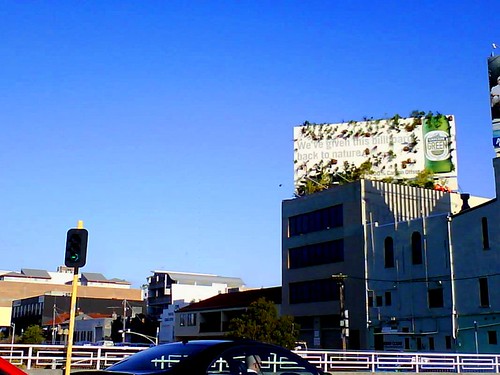
For the first time ever, a cross promotion with AlexofMelbourne, my poor second blog-child. I have been very tardy in updating my adventures in Melbourne, so in sorry attempt to give it some love I am giving it air-time in Love Number Two.
Here is a great billboard at St.Kilda Junction. Strangely, it was being erected on Friday evening.
This Cascade Green billboard had been erected a number of times in 2008 but this one in St.Kilda Junction is the biggest I have seen yet. Billboards, ever such a restrictive medium, rarely get loving such as this, so when they do it is refreshing to see and certainly catches the eye.
Let's just hope Melbourne gets some more rain over the coming weeks as I guess water restrictions will prevent Cascade from watering the plants!
Wednesday, February 25, 2009
A General Motors exec's view on the auto industry and advertising

With my shiny new RSS feed to the print edition of Advertising Age via ProQuest, I came across an interview with Bob Lutz (subscription reqd), retiring executive vice chairman-global product development.
In the interview Bob state's a few telling points - telling because I think it shows that some organisations just don't get it, from products to promotion. Here are the key out-takes from the article:
The entire industry is almost in intensive care, and we are going to be burdened with very, very, very severe fueleconomy mandates from an administration that believes all we have to do is show a little goodwill and we can easily achieve 43 miles to the gallon. Whereas, in fact, technologically, nobody knows how to do that.
Back in the old days, you had ABC, CBS and NBC. If you took three spots on the "Dinah Shore Show," you had a Chevrolet commercial at the beginning, one in the middle and one at the end, and you knew that about 25 million Americans saw those three Chevy commercials. Today, with hundreds of channels, you don't know where to go anymore. I can go a whole month and not see a GM commercial on TV because I am not watching the channels we advertise on. I tend to watch the channels like American Film Classics or something where I am bombarded with ads for medication.
But by and large, the industrial companies definitely no longer have the budgets to where they can rely on advertising. So you see a lot of very effective viral advertising. ... If you do an extremely entertaining commercial to where people will copy it and pass it on, it comes a chain of progression, and that is a very good way to get the message out.
So what we see from Bob Lutz is even at the very head of the organisation, there is no answer, no ideas, no inspiration. Not on the products side of things and not on the promotion side of things.
Let's now mosey on over to the "Social Media" side of GM's business. By any company standard these people should be the real innovators. And it looks promising, GM has covered its bases: A wiki, blogs, YouTube, Twitter. Well done, you're engaging with the people!
Let's take a look at how GM is engaging ...
Generations of GM Wiki is an historical account based on facts ... it is not a discussion forum.
The GMnext wiki
For centuries, Utopians have dreamed of letting the old world burn and building a fresh new world just over the horizon. In the case of the auto industry, which holds a key to solving the global energy puzzle, such dreams are a dangerous diversion from the hard work at hand.
GM Fastlane blog
@GMblogs you guys are killing Saturn just as it was starting to get interesting. I.e., becoming Opel/Vauxhall North America
4:01 AM Feb 20th from TweetDeck in reply to GMblogs
@buffalopundit if the spin-off happens Saturn will essentially get to cut the cord and go back to it's roots
4:15 AM Feb 20th from TweetDeck in reply to buffalopundit
GMblogs on Twitter
Hmmm... me-thinks GM has a nasty case of corporate communications cough, you know, that nasty bug that infects good ideas with yes-men touting the company line.
Oh, but i did find something that was interesting and did want to make me listen. It was an obscure GM produced video that has received a whopping 718 views in just a little over ... a year and a half!
Dr. Lars Peter Thiesen, GM Europe, manager, Hydrogen and Fuel Cell Development, actually sounds like an engaging, well spoken, and informative man, interested in the work he is doing.
So my big question to GM, Bob Lutz, GM bloggers and wiki editors: Why do I have to suffer the pain of Detroit's bemoaning corporate communicators when I could be reading the inspiring words of people like Dr. Lars Peter Thiesen? Where is the Dr. Lars blog?
Bob Lutz, on your way out, maybe make a recommendation to cut a couple of million from the corporate communications division, get your employees to blog about the great work they are doing (they'll do it for free!) and put that saved money back into worthy R&D.
BTW I did actually learn something useful from the GM Wiki! GM made electric cars as far back as 1912. Makes me wonder what happened for 100 years ...
Thursday, January 29, 2009
When content and advertising collide - head on

So it's official then, AMP is "nothing special". I've had this YouTube advertisement bugging my browser for the past week or so and never really paid much attention to it. Maybe because it is outside my F-shaped pattern of reading but more likely because I'm not interested in financial products.
Now that I have taken a better look at the advertisement I notice that, in fact, it allows ratings. I guess the question is then, is this sponsored content or is it advertising?
The fact that it is sitting in a traditional advertising right-hand column suggests that it is an advertisement, and when following the link you get to AMP's YouTube channel which is, for all intents and purposes, advertising AMP with informative content.
But, the fact that it allows ratings would suggest that it is more closely related to content, because heaven help the advertising industry if we could publicly rate every advertisement we see! So what is this picture sitting in my browser? Content or advertisement? If it is an advertisement as it would seem should we ask to be able to rate all advertisements online? Imagine that!
Conclusion? AMP's YouTube channel is a great attempt at advertising through content, but by having ratings in the advertisement portion of the campaign leaves it open to vandalism (by competitors?) that will lead to a negative impact on consumer perception.
*******
On a side note I see that AMP has had its YouTube account since 2005. Looks like some foresight on someone's behalf as no doubt 'AMP' would be a popular account to have!
Tuesday, January 20, 2009
More baby steps for Ad Agencies in the new-world

So yet another social media campaign is launched and shot down in flames within seconds of take-off. If it's not the UBank launchpad fizzer, or the agency-by-stealth undercover Guitar Hero video, then it's another agency built campaign that missed the final social-checklist question of: are we being legit with our customers?
This time we have Tourism Queensland's, "The Best Job in the World," a chance to be a caretaker on a Great Barrier Reef Island. Great concept, pretty good execution, but as always, one tiny flaw has earned a stern tut-tut from media old and new.
This time, as in the past examples, we again have advertising agency staff in the actual campaign without disclaimer or declaration. The ire of it all is that because they are posing in their own campaign they portray a skewed view of what the project has aimed to achieve.
I agree that undeclared 'planted' user generated content takes away from the spirit of social media campaigns, and I think that agencies that fall on this ground should be reminded about the spirit of the game. The spirit being, if you truly want to create such campaigns you must be ready to accept lame with the great, the creative with the boring, as long as there are no offensive or derogatory comments being made.
Mumbrella, has been on the inside of this case for a few days now and has some further insights from the parties involved. From these articles it is possible to see that innocent mistakes on a global scale do get noticed.
One thought on why these things seem to be happening is that much of the 'social media' activity is coming out of ad agencies still. Being two steps removed from the customer creates a little fog which can sometimes lead you to think a 'little' mistake doesn't mean much. I think it'll take time until Australia brings social media into daily marketing team activities. Using Zappos as the classic example, by having the 'social' part of your marketing inside the business, I think you can have a better understanding of exactly how to be 'social' with your customer.
**************************************
In other news...
Catching up on new years proceedings, I see that Julian Cole has posted that UBank have some new online videos. Looks like they must have cost a bomb, but it's your bank fees paying, so what do they care? So, good to see they're still in the game, a different take, but as above, it's still baby steps for the Australian digital space.
Friday, January 9, 2009
Cheers to a new look
To celebrate the launch of my new look I present the only thing cooler than my new blog...
here's to beer.
here's to beer.
Wednesday, December 24, 2008
Reb Bull gets it
Advertising nowadays is all about content - not the space in-between. We all know this. Red Bull has known this for years. From their paper aeroplane contests to their forumla one team and of course, their annual NYE Las Vegas crazy stunts.
2008/09 is looking absolutely crazy!
Friday, December 19, 2008
Ratings - what do they really say?
Here's a really good example of the different things simple ratings can tell you. Jared Spool on User Interface Engineering shows us that by comparing ratings of the same product on different websites you can get a very conflicting story.
Essentially one website was that of a bricks and mortar shop and the other was Amazon. Taking an example review from each website we could see that each review told essentially the same story but on one the product got 3 out of 5 stars and the other only 1 out of 5 stars.
The reason? Not the product but the customer service of the retailer.
Internally, for all events we rate based on a number of different KPIs. This allows us to find out what parts of the event performed well and which parts didn't. These ratings are not public, but it makes me think if they were to be made public, how would they be displayed? I wouldn't like to have five different 5-star ratings, but as we can see above, a single 5-star rating may be inadequate.
Essentially one website was that of a bricks and mortar shop and the other was Amazon. Taking an example review from each website we could see that each review told essentially the same story but on one the product got 3 out of 5 stars and the other only 1 out of 5 stars.
The reason? Not the product but the customer service of the retailer.
Internally, for all events we rate based on a number of different KPIs. This allows us to find out what parts of the event performed well and which parts didn't. These ratings are not public, but it makes me think if they were to be made public, how would they be displayed? I wouldn't like to have five different 5-star ratings, but as we can see above, a single 5-star rating may be inadequate.
Monday, December 8, 2008
There's only one must-have rule for being viral - be legit
Viral campaigns were born of necessity. Whether it was a small film production or cheap start-up business - both with no money - or a large brand that was getting no cut-through in other media. Both these examples had a necessity to go viral to get to their core market.
Some key components of viral campaigns are:
> Use non-traditional channels
> Be irreverent
> Be legit
The third one is the biggest one to get right, because if you're not legit you're going to get yourself into a whole lotta mess.
But what the hell is "being legit" when being viral? Isn't viral all about smoke and mirrors? planting the seed for discussion? Well, yes and no. Creating mystery is one thing, but trying to pull the wool over your customers eyes is another.
The best way to explain is to use examples.
BAD viral blogging - Walmartingacrossamerica - where a couple travel from Walmart to Walmart across America. It turned out this blog was funded by Walmart although no recognition was made. A description of the uproar can be found here.
And now we come to the next round of viral controversy - the viral video.
The past few weeks have been abuzz around a Guitar Hero video posted on You Tube that turned out to be created by the ad agency with the Guitar Hero account.
This is it:
The problem with it was that it never acknowledged that it was essentially made by Guitar Hero. Therefore you could assume that although it was 'virally' and amateurish there would have been a nice budget behind it. It's still a great video, but in the world of gaming, game makers are game makers and fans are fans - game makers cannot impersonate fans, the two worlds must not collide!
What happens when fans revolt? You get great parodies just like freddiw made (warning, this video seems to have been removed from You Tube).
So how do you get it right? Derek Powazek has suggested the EA video they created for Tiger Woods 09. EA did not start the joke, but thought it good enough to get in on. Essentially it started with a fan showing how in the new game Tiger Woods could walk on water. From there, EA had the last laugh!
Check it out:
There will be plenty more case studies on viral campaigns that get it right and those that get it wrong. They key is to be legit with your audience. You do not need to give away all the mystery, far from it, just make sure that if you have a vested interest, let the fans know. In the case of Guitar Hero it may have been as easy as posting the video on the Guitar Hero or ad agency's website with a caption - can you beat this?
Some key components of viral campaigns are:
> Use non-traditional channels
> Be irreverent
> Be legit
The third one is the biggest one to get right, because if you're not legit you're going to get yourself into a whole lotta mess.
But what the hell is "being legit" when being viral? Isn't viral all about smoke and mirrors? planting the seed for discussion? Well, yes and no. Creating mystery is one thing, but trying to pull the wool over your customers eyes is another.
The best way to explain is to use examples.
BAD viral blogging - Walmartingacrossamerica - where a couple travel from Walmart to Walmart across America. It turned out this blog was funded by Walmart although no recognition was made. A description of the uproar can be found here.
And now we come to the next round of viral controversy - the viral video.
The past few weeks have been abuzz around a Guitar Hero video posted on You Tube that turned out to be created by the ad agency with the Guitar Hero account.
This is it:
The problem with it was that it never acknowledged that it was essentially made by Guitar Hero. Therefore you could assume that although it was 'virally' and amateurish there would have been a nice budget behind it. It's still a great video, but in the world of gaming, game makers are game makers and fans are fans - game makers cannot impersonate fans, the two worlds must not collide!
What happens when fans revolt? You get great parodies just like freddiw made (warning, this video seems to have been removed from You Tube).
So how do you get it right? Derek Powazek has suggested the EA video they created for Tiger Woods 09. EA did not start the joke, but thought it good enough to get in on. Essentially it started with a fan showing how in the new game Tiger Woods could walk on water. From there, EA had the last laugh!
Check it out:
There will be plenty more case studies on viral campaigns that get it right and those that get it wrong. They key is to be legit with your audience. You do not need to give away all the mystery, far from it, just make sure that if you have a vested interest, let the fans know. In the case of Guitar Hero it may have been as easy as posting the video on the Guitar Hero or ad agency's website with a caption - can you beat this?
Thursday, November 13, 2008
Fail ad #003 - email marketing at its worst

Thanks to CEO of Socialtext, Eugene Lee, and his Twitter post for pointing out this Fail Ad that Zoli Edros has blogged about on Cloud Ave.
People received the above email ad in the USA which, when reading just looks like a badly worded spammy email, but when you find out the actual email subject line was ...
"If you want to keep your job, use Spoke"
... it is just plain bad.
This arrived via Twitter - the public soap box that kills brand reputation quicker than you can say "This subject line cost me my job". Here's how it goes: bad ad goes out to the public > Someone points it out on Twitter for being crap > their followers (we're talking in the hundreds) tell their followers (hundreds multiplied by hundreds) and step three > your brand reputation tanks.
I agree, you need a killer subject line to entice people to waste two minutes reading ANOTHER email, but the subject line needs to also inspire confidence. There's a reason all your viagra/debt/gambling spam starts with "big", "win", "huge", "now", "rich" - it's a simple formula that even the worst spammers know about.
So, Spoke, I would strongly suggest that you call up one of your customers that do email marketing for a living and get few pointers on how to actually write a proper subject line.
UPDATE: 14/11/2008
OK, So after sleeping on this post I think it may be a little harsh. Email marketing is a tough gig, so while I still think it's a very bad subject line, maybe the best criticism is some constructive feedback. Here's a few alternative subject lines that would also have worked:
"Be accurate in uncertain times - use Spoke"
"Uncertainty brings change - keep up with Spoke"
"Improve your targeting even in a changing market"
Monday, October 27, 2008
Selling social media internally

This great diagram comes from David Armano via Beeline labs. I've been following Beeline for a little while since their tribalization of business study came out, and now thanks to Beeline I'm going to be enjoying David's great visualisations of social media.
I like this diagram because I can relate. It's nothing spectacular, not new, and is not unique to social media. Anybody trying to run a traditional, easy-as-you-like competition is likely to have experienced this curve as well. This is the traditional effort vs status quo fight anybody in marketing will have faced.
The opportunity that social media has in this space is that it is relatively new. While there are plenty of precedents in like cases and like scenarios, social media is redefining what the legal precedents mean.
In the post-copyright era where you're more likely to get thanks for spreading the word rather than scorn for 'ripping off' others' work, the creative commons movement is an example of how social media and the socialisation of the Internet is changing the legal game altogether. A maxim that I like to work by in this era is to have the benefit to the customer/consumer in mind at all times.
Working from this angle, it is possible to work with legal (also branding and many other internal departments) to ensure that if it is a viral campaign that you want to do, then it is done for the right reasons and with the maximum benefit for the customer.
I think that it comes down to the old effort versus status quo scenario and if you have the right effort behind your project, and the right argument for customer benefit, then it is possible to keep that viral campaign flying.
And in the spirit of the post-copyright era I would like to assert David Armano's ownership of the original design of the following diagram (as also seen above), but with my own personal touch. In this remix of the diagram I've added a little Chuck Norris. The trajectory of your viral campaign is proportionate to the amount of effort behind your thinking and the customer benefit. If Chuck Norris were to launch a viral campaign he'd make sure that it'd fly fast and far and get to where he wanted it!

Wednesday, September 17, 2008
Brands joining social networks

OK, enough of the pie in the sky theory mumbo jumbo, let's get down and do a plain old list of what's what.
I'm going to try and create and update a list of brands that are entering and trying to engage in the social network space. I'm going to categorise the "brands" (this can include people too, when appropriate) and how many friends they have - a good ol' friend-off!
(For ease of listing I'm going to stay clear of musicians or traditional celebrities)
Please comment and add more!
Listing key: brand, network, friends @ date
Commercial
Carl's Jr's 3D avatar, MySpace, 59 @ 17/09/2008
Jeep, MySpace, 9,907 @ 17/09/2008
Kit Kat, YouTube, 19 @ 19/01/2009
My Sydney (Tourism NSW), MySpace, 202 @ 07/11/2008
Proudbaldamerican (Sam Eagle from the Muppets), MySpace, 326 @ 17/09/08 (plus you can also find Statler & Waldorf, Beaker, The Great Gonzo and the Swedish Chef!)
1234 Sensis directory, MySpace, 85 @ 17/11/2008
Volkswagen's Miss Helga, MySpace, 6,561 @ 17/09/2008
Vspink (Victoria Secret brand), MySpace, 9,575 @ 17/09/2008
Professional bodies / Services firms
AICPA's Benjamin Bankes, MySpace, 1726 @ 17/09/2008
Deloitte (global), Facebook, 4,788 @ 17/09/2008
Ernst & Young Careers - Australia, Facebook, 3,250 fans @ 17/09/2008
Political
Officiallaborspace (Kevin Rudd), MySpace, 24252 @ 17/09/2008
Malcolm Turnbull, MySpace, 271 @ 17/09/2008
Barack Obama, MySpace, 529395 @ 17/09/2008
John McCain, MySpace, 95785 @ 17/09/2008
Subscribe to:
Posts (Atom)