
Hot on the heals of my last post, here's another great example of web video powering innovation, from one of the Kings of web video innovation - TED.
Wednesday, September 15, 2010


Monday, September 13, 2010
Online video innovation from catwalks to tennis courts
 |
| Credit: Jim O'Connell |
First up is New York Fashion Week and the Times' analysis of how fashion labels are now skipping the middle-man and using the web to take the catwalk to the customer. Livestreaming fashion shows straight into retail stores or websites, many brands from Burberry to Marc Jacobs have embraced online video. The integration of live event and retail mediums means that these labels are now ready to make sales as soon as the new design hits the catwalk.
Second, the Times hits the tennis courts and shows how everyone from the juniors to the agents are using online video to study the professionals and find out what it takes to be the next Nadal. Juniors are using online video to study the techniques of the professionals, searching for videos of today's pros when they were juniors. Talent agents are also scouting the web, taking a short-cut to the courts by scanning highlight reels of juniors from across the globe.
As I've said plenty of times before, we're a visual society, we obtain so much meaning from what we see and I think these two examples further prove how online video is driving innovation across the board.
Friday, September 10, 2010
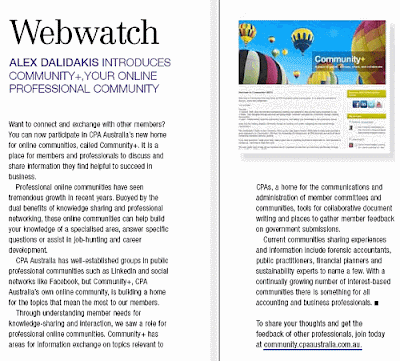
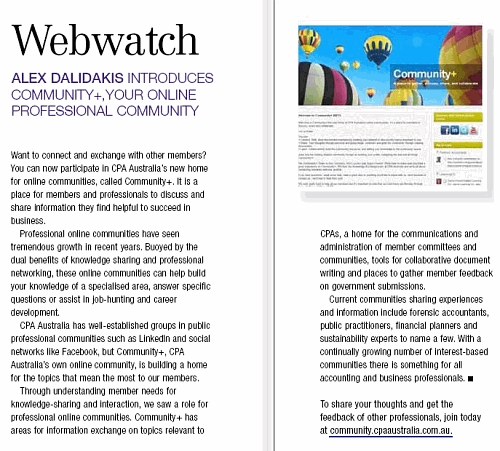
Online communities for accountants
So, the time has come that I finally get my name into the press (the printed press I mean...). Here is the article from CPA Australia's InTheBlack magazine (circulation 124,858).
Read it online here.
Read it online here.
Tuesday, August 31, 2010
3D Projection Mapping
Every couple of weeks a new example of 3D projection mapping is filmed and amazes me. Known also as architectural projection mapping and event outdoor amongst other terms, it is developed by mapping a real-world object with 3D animation software and creating artistic projections within and around the constraints of the real-world object.
It's an awesome example of augmented reality and from the examples below you can see it can be used for advertising, story-telling, live music, outdoor events, gallery spaces... so many incarnations of this fascinating cross-over art.
It's an awesome example of augmented reality and from the examples below you can see it can be used for advertising, story-telling, live music, outdoor events, gallery spaces... so many incarnations of this fascinating cross-over art.
Thursday, August 26, 2010
Can we have our 21st Century public infrastructure now?
![Flagman standing behind his train to flag oncoming trains at a small siding between Laguna, N[ew] Mex[ico] and Gallup, N[ew] Mex[ico]. Sant Fe R.R., Santa Fe trip (LOC)](http://farm3.static.flickr.com/2321/2179204906_dda250053a_m.jpg)
How refreshing to read an article about the NBN that links the roll-out of this infrastructure to broader economic and social policies.
Throughout the whole federal election campaign punters were subjected to red-herring analysis showing us how much it is going to cost us to get broadband in our home - $150 p/m!! $5000 per household!! We'll be broke!! All misleading, all missing the point.
When rail lines are built what unit of measure do we use? Is it cost per user? But what about the vital role rail plays in moving freight? Perish the thought the miners would be without rail line access to ports (well, that's a whole other infrastructure argument). When a (public) road is built do we measure it by how many mums take their kids to school on it? No, because these roads are also used by public transport, businesses, workers, and so many more people.
Fibre-optic broadband connectivity is the 21st Century's vital public infrastructure, it is not just another Foxtel or Bigpond. With even a casual look past this scaremongering it is pleasing to read commentary that actually identifies the following iniatives:
- The linking of all schools to the network
- The Smart Grid/Smart City project in Newcastle
- Telstra and NEC have signed agreements with medical organisations to deliver e-health services to 17,000 GPs and 28,000 retirement villages (and through them to patients via broadband-based monitoring services)
- Medicare services will be provided to regional Australia, including video-based medical consultations.
Wednesday, August 25, 2010
Contact you, but who?
 OK, I'm writing this post as if I'm writing about the last living dodo huddled in my hutch on a blustery deserted island, but I still feel it is important to write about. This near extinct creature that I write about today is your website's Contact Us email address.
Over the years I have been amused by some, delighted by the simplicity of others and shocked by the sheer randomness or internal focus of a few.
It might seem like a small point, but I think in the eyes of someone seeking the right information, the email address can say a lot.
If there is a specific purpose to the email address its great to somehow capture that purpose within the address, maybe something like Tumblr's support@ email address - it gets to the point. If there may not be a specific reason that you're contacting the business then something nice could be called for, I really like the welcoming nature of UBank's hello@ email address. Or if you'd like to reflect the nature of your business, maybe do something like creative agency, Breakfast, their email address is tiffany@ (get it?).
Tuesday, August 17, 2010
I'm optimistic about AR
 |
| credit: jntolva |
Augmented Reality. There I said it. I've said it before too, and I'll say it again and again.
I want to keep saying it because I was very disheartened when watching this video by recruiter La Volta in which many of Australia's leading digital figures deride augmented reality (AR) as a gimmick or fad. Summed up, I think this is un-imaginative.
Sure, if you're trying to create a snappy campaign for the latest Hollywood blockbuster the ideas to hook an AR app into the campaign will run dry pretty quickly. But if that's all you're thinking about when discussing AR, then you've kinda missed the point altogether.
AR provides a very real tangible layer between the physical world, its objects and locations, and the meta-world with its information and vast possibilities. Taking these meta topics, let's look at AR again.
Objects, information and vast possibilities
Getting further information regarding real-world objects is now within the capacity of AR. An example being the Metaio museum app, without needed to create those odd black and white objects, AR apps can now recognise detailed images such as paintings and overlay or direct you to web-links with info on that painting. The uniqueness of objects in the real-world shows us that AR might even be an alternative to QR codes in non-logistical industries.
On the vast possibilities end of the spectrum you have bright sparks thinking up uses such as the US Postal Service virtual box simulator. For real-world objects it just goes to show that AR can have tangible and practical applications, you just need a real-world problem to solve and a bit of creativity.
Location, information and vast possibilities
Just like objects, places have info we need to know about too, so it comes as no surprise that two of Australia's largest banks have released AR property-finder apps. Both Commonwealth Bank and St.George Bank now let you see real-estate information in situ.
More practicable, are examples such as the one pointed to me by Pete Williams by Open Australia Foundation. Called PlanningAlerts.org.au, this AR layer takes local council planning permits (high-rise apartments, anyone?) and overlays the information in the real-world. Used in conjunction with one of the property-finder apps, I can see a really good case forming for AR in what is one of our biggest lifetime purchasing decisions.
Going down the vast possibilities path but sticking with the home, GE has created an AR app that let's you form the mood of your home using lighting but without needing to spend a cent on light-bulbs until you've got it just right. Using the GE Moodcam you can take a photo of a home location and modify the lighting quality until it's right, then the app will point you in the right direction as to which lights will get you in that mood.
**********
Australian's are so good at creative problem-solving so I am sure that any cynicism towards AR will pass as soon as the right problem is found - much like the examples above. I'm really optimistic about AR, I hope that the Australian digital industry will jump on board too.
Tuesday, July 13, 2010
Things that get me down about Australia
Each day when I flick through the newspaper (those old things!) I like to form my own narrative around what the day's stories mean in the wider picture.
In today's Australian two stories, put together, really show to me what is wrong about Australia's current economic policies.

Picture one: Hoards of coal carriers parked outside Australian ports waiting to run-off with their fill of Australian coal. I have no doubt that the coal they just ran-off with was sold to them by a partly, if not wholly, foreign owned miner.

Picture two: Avaya closes their Australian R&D lab in a global consolidation. And dedicated local researchers get retrenched and probably move overseas.
This is what gets me down - Australia sitting back comfortably reaping the rewards from rock-kickers and hole-diggers while important industries like innovation and manufacturing gets shipped overseas.
When will the Australian government really act to retain and encourage the building of an innovative and highly-transformed economy?
In today's Australian two stories, put together, really show to me what is wrong about Australia's current economic policies.

Picture one: Hoards of coal carriers parked outside Australian ports waiting to run-off with their fill of Australian coal. I have no doubt that the coal they just ran-off with was sold to them by a partly, if not wholly, foreign owned miner.

Picture two: Avaya closes their Australian R&D lab in a global consolidation. And dedicated local researchers get retrenched and probably move overseas.
This is what gets me down - Australia sitting back comfortably reaping the rewards from rock-kickers and hole-diggers while important industries like innovation and manufacturing gets shipped overseas.
When will the Australian government really act to retain and encourage the building of an innovative and highly-transformed economy?
Thursday, July 1, 2010
Start-ups and reassurance for the client

There are a number of variables that I look for all of which I portion a weighting to, this then helps me form an overall level of reassurance for the business. Here are a couple of the variables that I look at:
Industry speed: In technology there is a big risk that businesses won't keep up with changes in technology standards or client demands, the faster the industry moves the bigger the risk. For this variable you have to know the industry back-to-front or, like me, read as much research and keep up-to-date with industry blogs.
Competition: Especially in tech companies the barriers to entry are very low so it is important to view the landscape for competitors and get an understanding for the sustainable competitive advantages of each. Forrester and Gartner research really helps for this variable.
Funding: This is a tricky one as you'd think News Corp buying MySpace for $580m would give you reassurance that it's a safe bet, alas... But still, looking at the funding sources for start-ups does give some level of reassurance. Look at the funding sources to see if they align with your business, eg Microsoft or Cisco capital investments in start-ups might align with your long-term infrastructure aims
Customers: Another tricky one, especially in tech start-ups. Look at how MoveNetworks lost Fox as a customer and saw the decline of a $70m business. Still, portioning some of your reassurance to existing customer relationships is worthwhile.
Now I know whole libraries have been written on this subject and from a Venture Capital or M&A perspective my analysis would probably not even get me a janitor's job in their marble-lined offices, but from a customer point of view it is these basic steps that has helped me sort out the hundreds of vendors out there.
What other variables should I add to my vendor scorecard? It'd be great to beef up my scorecard with more analysis.
Image credit: archangel12
Thursday, June 10, 2010
Non-linear video consumption and other fancy terms

The player has been designed for watching re-runs and has some pretty swanky functionality, none-more-so than the ability to drill down into non-linear content. For content producers and marketers alike I can see the salivating already occuring.
From a content producers point of view imagine that a bit-player in the show walks into shot and the fan isn't quite sure of the back-ground of the character - one click and it brings up a bio with background story of how they fit into the show.
From a marketers point of view, those product placements really can work for the money. Context sensitive links will now allow you to click on those sweet kicks the star is wearing and find out where they're on sale.
The other social functions of the player including Facebook and Twitter connections I have already written about previously and more and more these are a given with video consumption.
Truly social and interactive video consumption is coming very very quickly.
Image credit: Glee on Fox
Subscribe to:
Posts (Atom)