Wednesday, June 24, 2009

Billboard relevance


In my continuing fascination of the somewhat un-loved billboard I am really appreciating the Triple M footy billboards at the moment.

Not so much for creative, rather for its execution. In the series of billboards a different commentator is featured depending on the location of the billboard in the city.

Danny Frawley, pictured above, is featured in a billboard in Moorabbin near the home ground of his old club, St.Kilda. James Brayshaw is featured on a billboard near the Bolte Bridge in Kensington near the North Melbourne home ground where he is president. I suspect Shane Crawford and Jason Dunstall would be prominent in the eastern suburbs near Hawthorn.

Appealing to local allegiances in AFL is just one more way to use the benefits that a local billboard can offer.

Friday, May 29, 2009

The set-up of a mixed-reality event


So, I've been a bad blogger an not posted in a month. Tut tut. It's not to say I haven't been doing anything interesting!

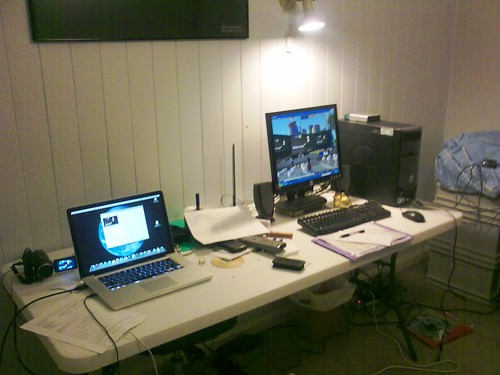
Check out the photo above. This is the set-up of a live stream that I conducted in Second Life. Well, as this picture is taken at home, it not a live 'live stream' but a 'repeat' live stream. Let me explain...

On May 12 I was at the CPA Week conference in Perth where I had a similar set-up at the back of a hall where a keynote presentation was taking place. Two Macs; one video camera, audio hook-up to sound desk; internet connection. Away we went!

Computer one. Audio link from presenter's lapel mic into DV camera. DV camera on tripod hooked up to computer with firewire cable. Live video feed into Quicktime Broadcaster. Feed sent to Quicktime streaming host, Netromedia.

Computer two. Second Life running with live feed into media texture on stage screen. Mac linked to plasma screen on stage.

The result?

A keynote presentation, once only available to those in the room, was now beamed into a theatre Second Life where CPA Australia members from all across the globe could log in and view the live presentation. The outcome of having the stream beamed back into the real life theatre was that those in the real life could see how other members were engaging in the presentation AND the members in SL, wherever they were, could pose questions to the presenter during question time in real-time.

It kinda does the head in trying to comprehend the whole mixed-reality phenomena, as trying to explain even after I have done it hard enough.

Now back to the 'not-quite-live' aspect of the photo above. As well as stream the event live I recorded the video feed to mini-DV tape and the set-up above was me re-playing the video for members that could not attend the live event. By playing the tape through the DV camera I could utilise the live-stream functionality of Broadcaster and Netromedia to replicate the live-feed at a more convenient time for other members.

The only question I have remaining is, is it possible to to the video feed 'out' and the Second Life stream 'in' on the one computer? I guess it's a question of grunt.

Seeing it live is perhaps the only way to truly grasp the potential for events in the future. The blending of realities is a fascinating future and one that has many possibilities.

Wednesday, April 22, 2009

Kleenmaid's foray into YouTube

Kleenmaid Appliances, an Australia whitegoods retailer went into voluntary administration on April 9 with an estimated debt of $73 million.

To provide Kleenmaid customers with an update on what this meant, the directors, Bradley Young and Andrew Young, took the unusual step of broadcasting a message via YouTube.

View it here. I have linked rather than embedded it because embedding permissions have been turned off.

As well, comments and response videos have also been turned off. What this says to me is that Kleenmaid had the best intentions for using YouTube as an engaging medium in what must be quite a stressful time. But the stress may have been too much, by turning off all forms of two-way communication this has meant people have circumvented this non-communication by other means.

Here are the examples to be found on YouTube today:


Yes, YouTube is full of weird and wonderful people, but like any other new media/social media platform, an inherent part of its purpose is to facilitate two-way communication. As seen in this example, people will call you out when you "don't play by the rules". And yes, going into voluntary administration must be stressful enough without having to respond to all the people of the interwebs. But if you choose YouTube as a form of communication then you should obey the etiquette and its reason for being.

Take for example GE. GE is a global manufacturing and financial services organisation that no doubt angers many people for various reasons. However, though its communications arm it has bitten the bullet and agreed to allow customers, shareholders and the public to comment on everything from its products to its financial performance through its GE Reports website and YouTube channel.

The worst that can happen is that you get a bad comment which, if defamatory, you can moderate. The best that can happen is that you can control the debate via responding to comments and centralising the debate.

Savvy businesses are realising that YouTube and two-way communications platforms are providing a whole new level of engagement with their customers and shareholders. By using these platforms to craft and moderate the debate much of the fire that comes out at retail outlets or shareholder meetings can be abated.

And on a final note out of all the saga of Kleenmaid and its stuttering foray into YouTube, here is my pick for the winner. Amos, a Kleenmaid technician from Adelaide that has had the foresight to respond to one of the negative Kleenmaid spoofs. Well done!

Friday, April 17, 2009

livestreaming around the world baby!

The below Windows Media Player and code is from a trial live stream I conducted. We live streamed from a notebook to my blog using Netromedia. Much coolness. Should you ever need to live stream yourself into your blog.

standby="Loading Microsoft Windows Media Player components..." type="application/x-oleobject"
width="382" height="306">


src="http://wms141.netromedia.net/cpatest" showcontrols="false" width="382" height="306"
filename="http://wms141.netromedia.net/cpatest" animationatstart="true" transparentatstart="true"
autostart="true">

Wednesday, April 8, 2009

How to choose the delivery format and channel for your news and information


These past few weeks I've been thinking a lot about online media. Actually, more like learning and online media.

I'm going to take it back a step and start on a tangent with long-players and short-players, the old dames of the music industry. You might remember the initials, LP, EP, SP; they denoted the length of the music.

That's where I'm taking my cue from when, now in the 21st Century, I think about not so much music, but news and learning media. You can break down news and learning (learning being podcasts, lectures, etc) media into the LP, EP, SP definitions by time, so that a 40min lecture is an LP; a 20min podcast is an EP; and a 5min news clip is an SP.

The LP,EP,SP analogy can be seen as blocks of concentration too. I might only have time for a short news clip or I might be on a train ride and have time for a whole lecture.

Back in the ol' 45 era you didn't have much of an option for media. You had the transistor for the news or the record player for the LP. The Internet has changed all that. using an iPhone as an example the one device can deliver you short-play and long-play audio and video.

The trouble is that this abundance of choice from the one device means that the content publishers need to think carefully about the manner in which they deliver their content. Delivering the right content but through the wrong channel might mean that your content never gets seen. Likewise delivering the right content in the right channel but in the wrong format could also be disastrous.

Just to give an example of the variety of channels for delivering your content here is a small selection:

SP media
Short bites of information, high volume and frequency.
  • YouTube
  • Yahoo! Video
  • Vimeo
  • Wikipedia's list of video services


    EP media
    mid-length media, once-a-week volume as example
  • The Podcast Network
  • Podcast.com
  • The BBC World Service

    LP media
    Full length lectures, keynote presentations, etc.
  • iTunes University
  • YouTube Edu
  • Academic Earth

    That's just the tip of the iceberg my friends. Take your pick. It's a consumer's market out there.

    So when you're a content publisher where do you start? How do you pick the winner for the content you want to put out there to the world? I'm still learning myself, but what I have learnt is that there are a few key factors that will determine your choice:

    Length
    Choose the length of your content delivery based on a consumer's appetite for knowledge of the topic.

    Medium
    Audio or video, choose based on what's required. There's nothing more frustrating than an podcast that refers to images or slides, similarly, a video of a guy standing behind a podium is pretty dull.

    Frequency
    News topics require constant periodic updates while specialist topics can have infrequent updates.

    Streaming or download
    You must accept that LP media will frequently be consumed over a number of sittings, therefore you should allow for downloading of this media, while SP media can be seen as disposable media and therefore streaming only is fine.

    Delivery channel
    This is totally subjective, but to me YouTube is a SP delivery channel, as it is streaming only I will only choose to watch SP media via YouTube. Whereas something like iTunes and iTunes University is an EP/LP delivery channel as it is a download channel.

    The consumer is spoilt for choice, the information age has truly arrived, as a publisher your voice is fighting amongst the cacophony of the whole world. Choose your format and channel wiseley!
  • Monday, March 30, 2009

    The big balloon, you can't avoid it

    Draught balloon

    Spotted over Caulfield race course this morning, the Carlton Draught big balloon is out and about again.

    Conveniently, there is two weeks left to register for the latest Carlton Draught competition, Drop the Bomb.

    Maybe it has been in town for the Grand Prix/AFL launch, maybe it is in the air to promote the latest competition. Either way, the hot air balloon is a great way to get attention.

    I remember in 2006, the Australian F1 GP launched a hot air balloon in the shape of an F1 car to gain attention during the Commonwealth Games. The hot air balloon is possibly one of the best tools in the ambush marketing tool-box.

    What-ever the balloon is doing in the sky, it's always a fun sight (well, the world's largest beer at 8am in the morning may not be the *greatest* sight).

    As an events promotional tool for sheer attention grabbing, it beats dancing girls, celebrity autograph signing, stunt cars, and all other manner of events promotions. It's big and it's there and you cannot avoid it!

    Wednesday, March 11, 2009

    Billboard usage (or lack thereof) in Melbourne CBD

    Elizabeth Street billboard

    As you can see above, this is a billboard for Will Smith's Seven Pounds film. It advertises, "In cinemas January 8". Why is this billboard still up?

    As my previous post shows, billboards are still being used quite creatively, even in this market. But then again, in the belt-tightened economy groceries (an alcohol) are still doing well. Maybe beer is the exception to the general outdoor advertising trend.

    Maybe outdoor advertising is feeling the pinch. You'd think a billboard near the corner of Bourke and Elizabeth Streets would be a snap to sell.

    But I have also noticed that the office tower at Melbourne Central is advertising three whole floors for rent. I don't think I've ever seen an vacancy advertisement on a building as popular as that.

    Maybe the doomsayers are right, things will certainly be interesting in the CBD over the next 12 months.

    Tuesday, March 10, 2009

    Cascade gives a billboard back to nature

    Cascade_Green

    For the first time ever, a cross promotion with AlexofMelbourne, my poor second blog-child. I have been very tardy in updating my adventures in Melbourne, so in sorry attempt to give it some love I am giving it air-time in Love Number Two.

    Here is a great billboard at St.Kilda Junction. Strangely, it was being erected on Friday evening.

    This Cascade Green billboard had been erected a number of times in 2008 but this one in St.Kilda Junction is the biggest I have seen yet. Billboards, ever such a restrictive medium, rarely get loving such as this, so when they do it is refreshing to see and certainly catches the eye.

    Let's just hope Melbourne gets some more rain over the coming weeks as I guess water restrictions will prevent Cascade from watering the plants!

    Wednesday, February 25, 2009

    A General Motors exec's view on the auto industry and advertising


    With my shiny new RSS feed to the print edition of Advertising Age via ProQuest, I came across an interview with Bob Lutz (subscription reqd), retiring executive vice chairman-global product development.

    In the interview Bob state's a few telling points - telling because I think it shows that some organisations just don't get it, from products to promotion. Here are the key out-takes from the article:

    The entire industry is almost in intensive care, and we are going to be burdened with very, very, very severe fueleconomy mandates from an administration that believes all we have to do is show a little goodwill and we can easily achieve 43 miles to the gallon. Whereas, in fact, technologically, nobody knows how to do that.


    Back in the old days, you had ABC, CBS and NBC. If you took three spots on the "Dinah Shore Show," you had a Chevrolet commercial at the beginning, one in the middle and one at the end, and you knew that about 25 million Americans saw those three Chevy commercials. Today, with hundreds of channels, you don't know where to go anymore. I can go a whole month and not see a GM commercial on TV because I am not watching the channels we advertise on. I tend to watch the channels like American Film Classics or something where I am bombarded with ads for medication.


    But by and large, the industrial companies definitely no longer have the budgets to where they can rely on advertising. So you see a lot of very effective viral advertising. ... If you do an extremely entertaining commercial to where people will copy it and pass it on, it comes a chain of progression, and that is a very good way to get the message out.


    So what we see from Bob Lutz is even at the very head of the organisation, there is no answer, no ideas, no inspiration. Not on the products side of things and not on the promotion side of things.

    Let's now mosey on over to the "Social Media" side of GM's business. By any company standard these people should be the real innovators. And it looks promising, GM has covered its bases: A wiki, blogs, YouTube, Twitter. Well done, you're engaging with the people!

    Let's take a look at how GM is engaging ...

    Generations of GM Wiki is an historical account based on facts ... it is not a discussion forum.

    The GMnext wiki

    For centuries, Utopians have dreamed of letting the old world burn and building a fresh new world just over the horizon. In the case of the auto industry, which holds a key to solving the global energy puzzle, such dreams are a dangerous diversion from the hard work at hand.

    GM Fastlane blog

    @GMblogs you guys are killing Saturn just as it was starting to get interesting. I.e., becoming Opel/Vauxhall North America
    4:01 AM Feb 20th from TweetDeck in reply to GMblogs

    @buffalopundit if the spin-off happens Saturn will essentially get to cut the cord and go back to it's roots
    4:15 AM Feb 20th from TweetDeck in reply to buffalopundit

    GMblogs on Twitter

    Hmmm... me-thinks GM has a nasty case of corporate communications cough, you know, that nasty bug that infects good ideas with yes-men touting the company line.

    Oh, but i did find something that was interesting and did want to make me listen. It was an obscure GM produced video that has received a whopping 718 views in just a little over ... a year and a half!

    Dr. Lars Peter Thiesen, GM Europe, manager, Hydrogen and Fuel Cell Development, actually sounds like an engaging, well spoken, and informative man, interested in the work he is doing.

    So my big question to GM, Bob Lutz, GM bloggers and wiki editors: Why do I have to suffer the pain of Detroit's bemoaning corporate communicators when I could be reading the inspiring words of people like Dr. Lars Peter Thiesen? Where is the Dr. Lars blog?

    Bob Lutz, on your way out, maybe make a recommendation to cut a couple of million from the corporate communications division, get your employees to blog about the great work they are doing (they'll do it for free!) and put that saved money back into worthy R&D.

    BTW I did actually learn something useful from the GM Wiki! GM made electric cars as far back as 1912. Makes me wonder what happened for 100 years ...

    Monday, February 23, 2009

    The difference between shopping in the real world and online


    So I've just come back from lunch and a few revelations came to me on my walk around town.

    1. The Internet has changed shopping forever. OK, we've known this one for years and years. But it was only today that I actually got depressed about it. I looked at all these great shops with their pretty displays and thought, "I could go online and fine ten times as much of anything you could possibly stock in your little store." The poor shop-owners don't have a chance, there is no-way a bricks and mortar store can ever compete on range. Ever.

    The depressing thing was that I like to touch and feel things, the texture, the look... yes I admit it, I like the SMELL of books. You can't get this online. This is the only thing the little stores have over the Internet. They have reality. Real people. Real customer service. All I can say is: little shops, customer service is the ONLY thing you have over the Internet - so used it well.

    2. The key is in engagement. Walking down the the street I also passed a large number of pamphleteers. You know the people with a little A5 photo-copy selling you something or telling you about the next rally organised by the socialist left.

    Most of the pamphleteers had it all wrong. Chatting to their buddies, casting a strange glare, handing you a pamphlet as if it were a controlled narcotic. It's not a hard thing, it does take a little technique, but shock-horror it's not hard. Smile, be open, say hello, say what you're giving the passer-by.

    Conclusion? The traditional shop must evolve. Utilise your best asset - customer service. Leverage the Internet for what you cannot provide - range - affiliates, distribution agreements. And for the online retailers? Take a lesson from the humble street pamphleteer. If your usability is poor, or you don't have an open and welcoming appearance, then people might pass you by. Say hello, put a face to your store, utilise your best asset - range. Take lessons from the real world on the things you can't offer - personal customer service, just because you're online, doesn't mean you can leave the customer in the wilderness.