Showing posts with label innovaton. Show all posts

Monday, July 25, 2011

QR Codes and merging print and digital media


The guys over at Marketing Magazine asked the question whether QR codes will ever take off in Australia and I think they will, in-fact they may have already. Just this week four catalogues in my letterbox had QR codes linking print media to its digital cousin.
  1. Woolworths promoting more recipes online
  2. Mitre 10 promoting DIY videos online
  3. Bunnings, similarly with DIY videos, but also with store locators
  4. Bras 'n Things with a store locator QR code
Without stats I can't say whether this has taken off or whether it's just the marketing department trying out new things. It does make me happy, though, that there seems to be a concerted effort to provide a more connected experience between the brand and the customer.

Finally, a question that I have had bubbling away for a while is, 'have we already surpassed qr codes?'.

Taking a logistical tool and turning it into a marketing key to the digital world was a great idea and it has been one that, overseas at least, has had great commercial success. But with the advent of Google Goggles and augmented reality (AR), where applications can now 'read' real-world objects, have 2D barcodes become obsolescent?

Google Goggles still has a long way to go before it is accurate enough to surpass QR code readers, and with no accepted standards in AR, I think that QR codes will have a healthy life yet in Australia. But we have already seen the future and for marketing at-least I think it is one without 2D barcodes.


Monday, July 11, 2011

Beach balls, LEDs, live music, creators projects

Can't believe it's taken me this long to discover the Vice/Intel Creators Project.

Creative and inventive minds together, a great combination. Looking forward to watching more videos like this one:

Installation using real-time data feed

This is really mesmerizing stuff, I think if I was at this museum I could sit still for a few hours and watch this installation.

Make Magazine has featured a video of this installation that takes real-time data from one of the remote oceanic buoys and uses it to create this simulation.

The way the poles snake up and down, it really does look like waves but at the same time if you dressed the poles up a bit you could be fooled to think it was a snake or even Falkor.

tele-present water from david bowen on Vimeo.


If you want to dig a little deeper, you can surf the worlds oceanic buoys at the NOAA.

Wednesday, September 15, 2010

TED on why web video powers innovation

Hot on the heals of my last post, here's another great example of web video powering innovation, from one of the Kings of web video innovation - TED.

Monday, September 13, 2010

Online video innovation from catwalks to tennis courts

Credit: Jim O'Connell
Two great articles in the New York Times have again highlighted how much online video is driving innovation and, "has democratized the access to excellence."

First up is New York Fashion Week and the Times' analysis of how fashion labels are now skipping the middle-man and using the web to take the catwalk to the customer. Livestreaming fashion shows straight into retail stores or websites, many brands from Burberry to Marc Jacobs have embraced online video. The integration of live event and retail mediums means that these labels are now ready to make sales as soon as the new design hits the catwalk.

Second, the Times hits the tennis courts and shows how everyone from the juniors to the agents are using online video to study the professionals and find out what it takes to be the next Nadal. Juniors are using online video to study the techniques of the professionals, searching for videos of today's pros when they were juniors. Talent agents are also scouting the web, taking a short-cut to the courts by scanning highlight reels of juniors from across the globe.

As I've said plenty of times before, we're a visual society, we obtain so much meaning from what we see and I think these two examples further prove how online video is driving innovation across the board.

Tuesday, August 31, 2010

3D Projection Mapping

Every couple of weeks a new example of 3D projection mapping is filmed and amazes me. Known also as architectural projection mapping and event outdoor amongst other terms, it is developed by mapping a real-world object with 3D animation software and creating artistic projections within and around the constraints of the real-world object.

It's an awesome example of augmented reality and from the examples below you can see it can be used for advertising, story-telling, live music, outdoor events, gallery spaces... so many incarnations of this fascinating cross-over art.


Thursday, August 26, 2010

Can we have our 21st Century public infrastructure now?

Flagman standing behind his train to flag oncoming trains at a small siding between Laguna, N[ew] Mex[ico] and Gallup, N[ew] Mex[ico]. Sant Fe R.R., Santa Fe trip (LOC)

How refreshing to read an article about the NBN that links the roll-out of this infrastructure to broader economic and social policies.

Throughout the whole federal election campaign punters were subjected to red-herring analysis showing us how much it is going to cost us to get broadband in our home - $150 p/m!! $5000 per household!! We'll be broke!! All misleading, all missing the point.

When rail lines are built what unit of measure do we use? Is it cost per user? But what about the vital role rail plays in moving freight? Perish the thought the miners would be without rail line access to ports (well, that's a whole other infrastructure argument). When a (public) road is built do we measure it by how many mums take their kids to school on it? No, because these roads are also used by public transport, businesses, workers, and so many more people.

Fibre-optic broadband connectivity is the 21st Century's vital public infrastructure, it is not just another Foxtel or Bigpond. With even a casual look past this scaremongering it is pleasing to read commentary that actually identifies the following iniatives:
  • The linking of all schools to the network 
  • The Smart Grid/Smart City project in Newcastle 
  • Telstra and NEC have signed agreements with medical organisations to deliver e-health services to 17,000 GPs and 28,000 retirement villages (and through them to patients via broadband-based monitoring services) 
  • Medicare services will be provided to regional Australia, including video-based medical consultations.
Finally an article that shows that the economic benefits of the NBN will be spread throughout all industries, and more importantly throughout an individual's life (not just their home internet connection).

Tuesday, August 17, 2010

I'm optimistic about AR

credit: jntolva
Long time between drinks, I know, but I've now forced myself to get on with blogging about something that has been nagging at me for weeks.

Augmented Reality. There I said it. I've said it before too, and I'll say it again and again.

I want to keep saying it because I was very disheartened when watching this video by recruiter La Volta in which many of Australia's leading digital figures deride augmented reality (AR) as a gimmick or fad. Summed up, I think this is un-imaginative.

Sure, if you're trying to create a snappy campaign for the latest Hollywood blockbuster the ideas to hook an AR app into the campaign will run dry pretty quickly. But if that's all you're thinking about when discussing AR, then you've kinda missed the point altogether.

AR provides a very real tangible layer between the physical world, its objects and locations, and the meta-world with its information and vast possibilities. Taking these meta topics, let's look at AR again.

Objects, information and vast possibilities
Getting further information regarding real-world objects is now within the capacity of AR. An example being the Metaio museum app, without needed to create those odd black and white objects, AR apps can now recognise detailed images such as paintings and overlay or direct you to web-links with info on that painting. The uniqueness of objects in the real-world shows us that AR might even be an alternative to QR codes in non-logistical industries.

On the vast possibilities end of the spectrum you have bright sparks thinking up uses such as the US Postal Service virtual box simulator. For real-world objects it just goes to show that AR can have tangible and practical applications, you just need a real-world problem to solve and a bit of creativity.

Location, information and vast possibilities
Just like objects, places have info we need to know about too, so it comes as no surprise that two of Australia's largest banks have released AR property-finder apps. Both Commonwealth Bank and St.George Bank now let you see real-estate information in situ.

More practicable, are examples such as the one pointed to me by Pete Williams by Open Australia Foundation. Called PlanningAlerts.org.au, this AR layer takes local council planning permits (high-rise apartments, anyone?) and overlays the information in the real-world. Used in conjunction with one of the property-finder apps, I can see a really good case forming for AR in what is one of our biggest lifetime purchasing decisions.

Going down the vast possibilities path but sticking with the home, GE has created an AR app that let's you form the mood of your home using lighting but without needing to spend a cent on light-bulbs until you've got it just right. Using the GE Moodcam you can take a photo of a home location and modify the lighting quality until it's right, then the app will point you in the right direction as to which lights will get you in that mood.

**********

Australian's are so good at creative problem-solving so I am sure that any cynicism towards AR will pass as soon as the right problem is found - much like the examples above. I'm really optimistic about AR, I hope that the Australian digital industry will jump on board too.

Tuesday, July 13, 2010

Things that get me down about Australia

Each day when I flick through the newspaper (those old things!) I like to form my own narrative around what the day's stories mean in the wider picture.

In today's Australian two stories, put together, really show to me what is wrong about Australia's current economic policies.


Picture one: Hoards of coal carriers parked outside Australian ports waiting to run-off with their fill of Australian coal. I have no doubt that the coal they just ran-off with was sold to them by a partly, if not wholly, foreign owned miner.


Picture two: Avaya closes their Australian R&D lab in a global consolidation. And dedicated local researchers get retrenched and probably move overseas.

This is what gets me down - Australia sitting back comfortably reaping the rewards from rock-kickers and hole-diggers while important industries like innovation and manufacturing gets shipped overseas.

When will the Australian government really act to retain and encourage the building of an innovative and highly-transformed economy?

Thursday, July 1, 2010

Start-ups and reassurance for the client

As a client that uses a number of new technology businesses that could be defined in the 'start-up' vein one of the things that I constantly look for is reassurance that there is sustainable substance behind the beauty parade and that the business will keep pace with industry and client demands.

There are a number of variables that I look for all of which I portion a weighting to, this then helps me form an overall level of reassurance for the business. Here are a couple of the variables that I look at:

Industry speed: In technology there is a big risk that businesses won't keep up with changes in technology standards or client demands, the faster the industry moves the bigger the risk. For this variable you have to know the industry back-to-front or, like me, read as much research and keep up-to-date with industry blogs.
Competition: Especially in tech companies the barriers to entry are very low so it is important to view the landscape for competitors and get an understanding for the sustainable competitive advantages of each. Forrester and Gartner research really helps for this variable.
Funding: This is a tricky one as you'd think News Corp buying MySpace for $580m would give you reassurance that it's a safe bet, alas... But still, looking at the funding sources for start-ups does give some level of reassurance. Look at the funding sources to see if they align with your business, eg Microsoft or Cisco capital investments in start-ups might align with your long-term infrastructure aims
Customers: Another tricky one, especially in tech start-ups. Look at how MoveNetworks lost Fox as a customer and saw the decline of a $70m business. Still, portioning some of your reassurance to existing customer relationships is worthwhile.

Now I know whole libraries have been written on this subject and from a Venture Capital or M&A perspective my analysis would probably not even get me a janitor's job in their marble-lined offices, but from a customer point of view it is these basic steps that has helped me sort out the hundreds of vendors out there.

What other variables should I add to my vendor scorecard? It'd be great to beef up my scorecard with more analysis.


Image credit: archangel12

Thursday, May 6, 2010

Taking science to the people

I was never a big science student in school - my young brain just didn't compute maths, physics and chemistry. So for me, and this is in the late 90s - not long ago - that's pretty much where science ended (apart from stats which through marketing I learnt to lurrrv).

Back in the day that's all that Science had to offer, there was science hard-core or science fiction and that was it. Science fiction was fun but as the plot was based more around impending alien death, the science of the story never really came through

But what I'm seeing more and more today is that science is learning how to open the door to the lay-people like me and expose a whole new generation to the wonders of science without the need for PhDs or mammoth left brains.

For me two examples really stand out. The first example is the socialising of science for the masses. NASA has been an excellent exemplar of this through its pro-active use of social media and willingness to share discoveries. Probably the most famous example of this is the Mars Phoenix Twitter account where in plain English first-person prose the Rover narrates its discoveries to all who want to listen. To see the extent to which NASA shares its discoveries see their Connect page. Another example of taking real science to the masses in much the same way is the CERN laboratory and the implementation of the Large Hadron Collider, you can follow the world's biggest laser beam on Twitter.

Secondly, social creations of science theory have really stepped up in the past couple years though with concerted efforts to build engaging and accessible ARGs and serious games.

Alternate Reality Games (ARGs) with a science bent have brought the real world of science into an intriguing new realm that is part science fiction but with science squarely the focus of the narrative. Examples of recent implementations include World Without Oil  and an ARG currently running in Australia called Bluebird. Bluebird is an ARG developed to further the understanding of Climate Change and the role that Geo-engineering might play in combating it. It's a great concept and by bringing real-world science and debates into a fictional narrative it exploits all modern-day engagement techniques for the youth demographic but firmly puts science as the main character in the story.


Lying somewhere left of ARGs comes serious games. With less narrative and more emphasis on game-play, serious games are attempting to both teach participants information while in a role reversal of sorts, many serious games also try and learn from the experiences of the participants too.

Two examples of serious games that came to light today, that both strangely have similar plots, are Participatory Chinatown - a 3D immersive game aimed to improve the master planning process for Boston's Chinatown precinct; and CityOne - a Sim-city like game developed by IBM to teach people about real world city planning problems (it's fixing leaky pipes time - no more aiming for the ritzy hotel on your block!).

In summary, science doesn't need to start and end in the text-book and many organisations are learning that some of the biggest scientific wins can be made simply by getting lay-people to understand concepts and actively participate in their solutions.

While I can leave many of today's complex theorems to the real boffins, I'm happy that I can now participate in science on a social level.


Image credit: nasa1fan/MSFC

Monday, March 22, 2010

Integrating your loyalty program into your customers communities

So you're a retailer and you have a customer loyalty program, nothing new there, everyone does. But until now this has been a mostly one-to-one relationship. Maybe you're a forward thinking company like Sears and have built a community for your loyalty program or like Best Buy and built a youth community for a specific segment of your customers. Breaking the one-to-one mould and exposing loyal customers to each other, great.

This means big bikkies to create a community platform from scratch and one of the down sides of this is that your brand is essentially insulated within its own community boundaries. For smaller retailers there is an alternative that can generate exposure as well as community.

I originally got on this train of thought when I read a blog post by platform vendor Lithium and their integration of Foursquare into their platform. This was more of a comment on bringing outside community mentions into an enterprise community, but the concept of blending inside and outside communities is essentially the same.

And now I have come across Tasti D-lite, a US ice-cream chain that has really taken social media integration to the next level for small business.

You can read more about how Tasti D-lite have brought social media into their loyalty program here, but essentially what they have done is leverage the power of their customer's existing free and public networks to promote their own loyalty program.

For USD$10,000 Tasti D-lite integrated Twitter and Foursquare into their loyalty program and POS system so that when a transaction is made using the loyalty program card a Tweet is sent with how many points were awarded and a check-in is made in Foursquare for the customer.

Setting aside the mammoth amount of small business activity in Facebook, this example shows how for relatively small amounts of money small businesses can leverage the power of their customer's existing networks to build brand and loyalty together.

Monday, November 2, 2009

New ways of consuming and learning (through transmedia and a broadening education model)

If necessity is the mother on invention, then demand must surely be the foreplay.

Through a convergence of a number of ways of thinking I'm slowly putting together the story about how the future of learning and consuming will take place. Let me begin with a quote:

As more of our basic needs are met, we increasingly expect sophisticated experiences that are emotionally satisfying and meaningful. These experiences will not simply be products. They will be complex combinations of products, services, spaces, and information.


This is Tim Brown of IDEO in his June 2008 Harvard Business Review article on design thinking. The quote encompasses a lot of what I also view the future to be and the demand for this way of thinking is permeating our entire society.

Two examples to kick-off, what I believe will be a fair amount of future blogposts, are transmedia and the broadening of the education model.

Transmedia (here's the wikipedia entry) roughly is the creation and delivery of a story across multiple forms of media. Here's a nice and thorough history to get you started on cross/trans-media from transmedia creator and chronicler Christy Dena.

While from Christy's preso you'll see that transmedia story telling is nothing new, especially in the world of fiction and film production, I think that it is getting more and more common. We are not surprised to see a computer game released at the same time as the latest Marvel cinema release, we expect it. Or when District 9 was promoted at Comic-con in the US, it wasn't mind-blowing that a team of MNU trucks locked down San Diego and a series of pre-graffitid posters sprung up over night. This is just how we demand movies to be sold to us now.

Some might say its all about eye-balls, that if consumers are switching off the TV in favour of the Web then naturally the dollars will follow where the eye-balls go. And this is right, but at the same time there is another aspect to transmedia that we are demanding and its that of reciprocity and co-creation.

Reciprocity in that if I am going to follow a story across media (chase the rabbit down the hole as it were) then I'm going to want reward in return. Mindless consumption via the idiot-box is over, mindful consumption through multiple media now commands respect. In as much, free downloads now act as rewards for following story-lines, prizes via ARGs go to those who dig the deepest into a story and online games attached to stories act as town-squares where consumers consume together.

And consuming together brings me onto my next point about co-creation. That a story is filmed/written, edited and distributed was once a nice process that meant everyone could play their part, received a cheque and go home to bed. Unfortunately for producers it isn't that simple any more. Consumers are now talking back, they're asking for more, wanting to get involved even. Which is where co-creation is creeping in. We see this now with characters jumping from pre-recorded episodes to live and interactive Twitter accounts (see the current Girl Number 9 web-series).

And of course, this brings me to an article I spotted in today's The Age about beating boredom in the school classroom. The article recounts the experiences and parents and teachers where students are skipping school due to boredom and some of the tactics schools are implementing to confront this problem. Not surprisingly transmedia story telling and co-creation play a large part in turning the problem around:

At Balwyn, students in years 7 to 9 start a program by watching a DVD that acts as a springboard for activities that are integrated across their subjects ...


... Resolving conflict — a theme of the movie — would be discussed in tutorial groups, with each group creating a movie to be presented at the final school assembly.

In turn, year 8 students will film news broadcasts as part of their sustainability program and year 9 students will enter into a music video competition as part of their program.


At my own work, we've been trying to extend the experience of our annual CPA Congress and broaden learning opportunities through changing what's expected (like conferences and training seminars) to providing the new and un-expected (like Second Life conference sessions and made-for-YouTube histories of members experiences).

Transmedia storytelling and the broadening of the education model are to me just two observations of how demand for a more sophisticated and communal way of consumption are mutating the old model of thinking.

So to those who still see this as an experiment or something that 'those' people do not us, all I can say is that it's too late already. The lines of communication will continue to blur. Teachers, soon your students will talk directly to you textbook author and bypass your meagre thoughts. Movie producers, make sure you keep your writers on the payroll because the writing doesn't end when the movie studio commissions your movie. I want to talk to your characters, and I expect them to listen. Between how it was and how it is now is a pretty big pill to take and takes a hell of a lot of effort, but as Tim Brown said, "we increasingly expect sophisticated experiences that are emotionally satisfying and meaningful."

Friday, August 14, 2009

Imagine a subversive world delivered via augmented reality


This just blew my mind with the possibilities.

From the Digital Urban blog...

A new application from Metaio is taking the concept a step forward allowing users to leave tweets, messages, web pages and 3D models in a real space for other users to view or pick up when there are in the vicinity.


An example Digital Urban gives is the opportunity for augmented reality graffiti. Wow, the possibilities for a really subversive world hidden from reality, open only to those with the right key... wow.

Overcoming the dis-embodied brain

Recently a colleague has had to work from home for extended periods. Today's technology is amazing in that it is wholly possible to do this and still work productively. With remote access to work and email applications via Citrix, diversion of office phones to mobile phones, and the use or web based wikis, IM and twitter there is no impediment to seamless remote working.

But there is a down-side. It pyschological more than anything else. It's dis-embodiment.

After a period of working with my colleague in a remote manner, the image of my colleague is fading and being replaced with the direct image I see during our converasations - a conference phone, a computer screen. It's crazy, I know, but he is turning into a dis-embodied brain, a god floating in the ether.

But there is another way. It may be a little data intensive and some options are down-right mind-blowing in their cost, but there should be no restriction in today's technologically capable world from not have visual and audio connections in remote locations.

Here are just a few options organisations can and should consider for employees working remotely:

Online video calls
Google and Skype both offer free one-to-one video calls.

Virtual worlds
Not as silly as it sounds, virtual worlds are promising to deliver the next generation of remote conferencing and offer unlimited flexibility in communicating with life-like representations of colleagues. Workplace virtual world examples include Forterra, Rivers Run Red for Second Life and some organisations are even trialling PS3 Home as a virtual communications medium.

Telepresence
TelePresence is something that Cisco has championed and the innovations coming out of Cisco really do show where remote working is heading. Life-sized imagery broadcast over digital lines is pretty amazing.

Holography
And just to show you there is always something way out there. The video below show's the next next generation of teleconferencing - Princess Leia style - holography in the boardroom.


Home offices and SMEs are perfectly positioned to leverage free online video technologies such as Google video and Skype. Larger organisations should consider distributed telepresence. I say distributed because I believe that having a system locked down to office-to-office video calls misses an opportunity to link in staff at home, customers and suppliers that all have webcams that could link in.

These are our best options for really tangible and meaningful connections via remote locations, we should embrace visual connections as much as possible and shun the dis-embodied soul.

Wednesday, July 15, 2009

The growing world of Augmented Reality

Disclaimer: I'm writing this blog post with no, repeat NO, technical understanding about how AR works, so keep that in mind.

Augmented Reality (or just AR) is picking up steam, largely i think off the back of new powerful mobile devices a la iPhone and the likes.

New AR applications are being released almost every week. They seem to be falling into two camps at the moment: Practical tools or gimiky advertising.

The gimiky advertising use of AR has built up steam and while some in advertising might lament the over-use of AR and the questionable tangible benefits, it is had to go past the "we're doing it because it's cool" arguement, because frankly, it is cool.

Here's a few examples of advertising uses of AR:


On the practical side of things, there are plenty more tangible benefits. By watching the clips below you'll see that assisting technical operations and overlaying information on points of interest are just some of the great ways AR can help bring real-time information to real world situations.

Here's a few examples of practical uses of AR:


The rumor mill has it that Apple will bring out AR support for the iPhone later this year - it'd be a hard one for Apple to pass by with the amount of applications possible.

You may be in the 'why isn't one reality enough?' camp or you might be in the 'bring it on' camp but the short of it is that mobile devices and demand for real-time information mean that reality and virtual reality are on a collision course and AR is how it is playing out.

Oh, and i'll leave the last word to a comment posted by mihaiviteazu5 on YouTube,":D idiot proof , the way of the future".

Friday, May 29, 2009

The set-up of a mixed-reality event


So, I've been a bad blogger an not posted in a month. Tut tut. It's not to say I haven't been doing anything interesting!

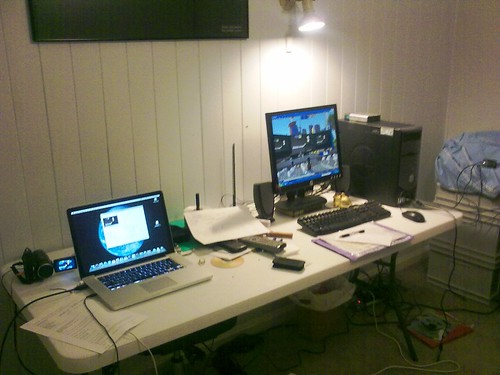
Check out the photo above. This is the set-up of a live stream that I conducted in Second Life. Well, as this picture is taken at home, it not a live 'live stream' but a 'repeat' live stream. Let me explain...

On May 12 I was at the CPA Week conference in Perth where I had a similar set-up at the back of a hall where a keynote presentation was taking place. Two Macs; one video camera, audio hook-up to sound desk; internet connection. Away we went!

Computer one. Audio link from presenter's lapel mic into DV camera. DV camera on tripod hooked up to computer with firewire cable. Live video feed into Quicktime Broadcaster. Feed sent to Quicktime streaming host, Netromedia.

Computer two. Second Life running with live feed into media texture on stage screen. Mac linked to plasma screen on stage.

The result?

A keynote presentation, once only available to those in the room, was now beamed into a theatre Second Life where CPA Australia members from all across the globe could log in and view the live presentation. The outcome of having the stream beamed back into the real life theatre was that those in the real life could see how other members were engaging in the presentation AND the members in SL, wherever they were, could pose questions to the presenter during question time in real-time.

It kinda does the head in trying to comprehend the whole mixed-reality phenomena, as trying to explain even after I have done it hard enough.

Now back to the 'not-quite-live' aspect of the photo above. As well as stream the event live I recorded the video feed to mini-DV tape and the set-up above was me re-playing the video for members that could not attend the live event. By playing the tape through the DV camera I could utilise the live-stream functionality of Broadcaster and Netromedia to replicate the live-feed at a more convenient time for other members.

The only question I have remaining is, is it possible to to the video feed 'out' and the Second Life stream 'in' on the one computer? I guess it's a question of grunt.

Seeing it live is perhaps the only way to truly grasp the potential for events in the future. The blending of realities is a fascinating future and one that has many possibilities.

Wednesday, February 25, 2009

A General Motors exec's view on the auto industry and advertising


With my shiny new RSS feed to the print edition of Advertising Age via ProQuest, I came across an interview with Bob Lutz (subscription reqd), retiring executive vice chairman-global product development.

In the interview Bob state's a few telling points - telling because I think it shows that some organisations just don't get it, from products to promotion. Here are the key out-takes from the article:

The entire industry is almost in intensive care, and we are going to be burdened with very, very, very severe fueleconomy mandates from an administration that believes all we have to do is show a little goodwill and we can easily achieve 43 miles to the gallon. Whereas, in fact, technologically, nobody knows how to do that.


Back in the old days, you had ABC, CBS and NBC. If you took three spots on the "Dinah Shore Show," you had a Chevrolet commercial at the beginning, one in the middle and one at the end, and you knew that about 25 million Americans saw those three Chevy commercials. Today, with hundreds of channels, you don't know where to go anymore. I can go a whole month and not see a GM commercial on TV because I am not watching the channels we advertise on. I tend to watch the channels like American Film Classics or something where I am bombarded with ads for medication.


But by and large, the industrial companies definitely no longer have the budgets to where they can rely on advertising. So you see a lot of very effective viral advertising. ... If you do an extremely entertaining commercial to where people will copy it and pass it on, it comes a chain of progression, and that is a very good way to get the message out.


So what we see from Bob Lutz is even at the very head of the organisation, there is no answer, no ideas, no inspiration. Not on the products side of things and not on the promotion side of things.

Let's now mosey on over to the "Social Media" side of GM's business. By any company standard these people should be the real innovators. And it looks promising, GM has covered its bases: A wiki, blogs, YouTube, Twitter. Well done, you're engaging with the people!

Let's take a look at how GM is engaging ...

Generations of GM Wiki is an historical account based on facts ... it is not a discussion forum.

The GMnext wiki

For centuries, Utopians have dreamed of letting the old world burn and building a fresh new world just over the horizon. In the case of the auto industry, which holds a key to solving the global energy puzzle, such dreams are a dangerous diversion from the hard work at hand.

GM Fastlane blog

@GMblogs you guys are killing Saturn just as it was starting to get interesting. I.e., becoming Opel/Vauxhall North America
4:01 AM Feb 20th from TweetDeck in reply to GMblogs

@buffalopundit if the spin-off happens Saturn will essentially get to cut the cord and go back to it's roots
4:15 AM Feb 20th from TweetDeck in reply to buffalopundit

GMblogs on Twitter

Hmmm... me-thinks GM has a nasty case of corporate communications cough, you know, that nasty bug that infects good ideas with yes-men touting the company line.

Oh, but i did find something that was interesting and did want to make me listen. It was an obscure GM produced video that has received a whopping 718 views in just a little over ... a year and a half!

Dr. Lars Peter Thiesen, GM Europe, manager, Hydrogen and Fuel Cell Development, actually sounds like an engaging, well spoken, and informative man, interested in the work he is doing.

So my big question to GM, Bob Lutz, GM bloggers and wiki editors: Why do I have to suffer the pain of Detroit's bemoaning corporate communicators when I could be reading the inspiring words of people like Dr. Lars Peter Thiesen? Where is the Dr. Lars blog?

Bob Lutz, on your way out, maybe make a recommendation to cut a couple of million from the corporate communications division, get your employees to blog about the great work they are doing (they'll do it for free!) and put that saved money back into worthy R&D.

BTW I did actually learn something useful from the GM Wiki! GM made electric cars as far back as 1912. Makes me wonder what happened for 100 years ...

Friday, February 20, 2009

Taking window dressing to the next level


Big ups to Olivia Solon from Right Brain, Left Brain and her post on the above Coraline ambient media.

It's this kind of imagination that keeps on inspiring me. While the video touts the five technologies it uses, that's just the sales pitch, it is really the execution of them all that makes it an amazing campaign.

Plus it puts Augmented Reality to use in a fun and engaging way!

Friday, November 28, 2008

What is the future for books?


I was waiting in the airport terminal the other day and decided that it was the right time for a new book. I was already reading one, but needed a fresh one to get me through yet another flight.

Now, I don't think I'm cheap, but for normal reading books (novels or history books) I try and set myself a AUD$30.00 limit. Now I think that is reasonable. With the price of CDs and DVDs plummeting in the face of more and more online content, when I buy a physical object I am demanding a lot more of it because I can just get it online otherwise.

So, when I found a book that I like - an Australian book published and (hopefully) printed in Australia - only to find it cost $37.95 I was shocked to say the least. The book, The Land of Plenty, by Mark Davis and published by Melbourne University Press, is $36.95 direct from the publisher, and $36.99 from Angus and Robertson so it wasn't just the airport book shop trying to get one over me.

Sure, this book probably caters for a niche market, and the costs of such a small run probably don't allow for any discounts, but surely there must be a cheaper alternative and I know there is.

E-book readers have been around for a while now but the average price is still sitting somewhere between US$300-500, so they are not cheap. But the fact of the matter is that from a publishers point of view the e-book should be a fairly compelling avenue to pursue. The value of a publishers work is in the IP the works contain and the traditional paperback has only been a means for distribution.

The difficulty in e-book readers is that they are trying to specialise with EInk display screens that are much more easy on the eyes than traditional back-lit laptops or PDAs. Because of this specialising, easy-on-the-eyes e-book readers have been held into a fairly niche market.

But, the technology is only ever one part of the equation. If the boffins at DELL, ASUS or HP were given enough incentive I'm sure they could create a pretty good easy-on-the-eyes screen mode on a normal tablet PC or PDA. Another reason for the limited e-book market is the ever-present rights management.

Amazon have been able to manage publishers IP through a DRM format of text and uses a direct Internet link from Amazon to the Amazon Kindle therefore assisting to make sure the text doesn't fly off online in the middle of the night. Other e-book providers have also created their own DRM formats, but as we have seen through the Walmart MP3 DRM fiasco customers are becoming more and more wary of DRM supported formats because of their tendency to disappear.

The only reason books have not gone the way of the DVD or CD is the fact that no-body apart from Google and a few universities could be bothered flipping so many pages over a scanner to digitise the books and as yet the hackers haven't decided to infiltrate publishers to get digital versions of new release books.

So what does this all mean? For me it means that as with the dodo and soon the CD and DVD, the paperback is destined to become extinct because the case for costs savings in publishing is too compelling for publishers. But, as with audio and visual arts, the global management of IP in a digital world has meant that e-books are being published at a snails pace.

I am hoping that when publishers and authors come around the the post-copyright era and embrace creative commons and digitised books we will be able to download books that we want to read for a fraction of the paperback cost whilst saving one more tree in the tropics.

Check-list for a post paperback world:

* Integrated PDA/phone/e-book back-lit/Eink reading panel
* Non-DRM file format
* International IP agreement (Creative Commons?)
* Value-added services (audio/video integration, authors blogs, hyperlinked bibliography ...)